


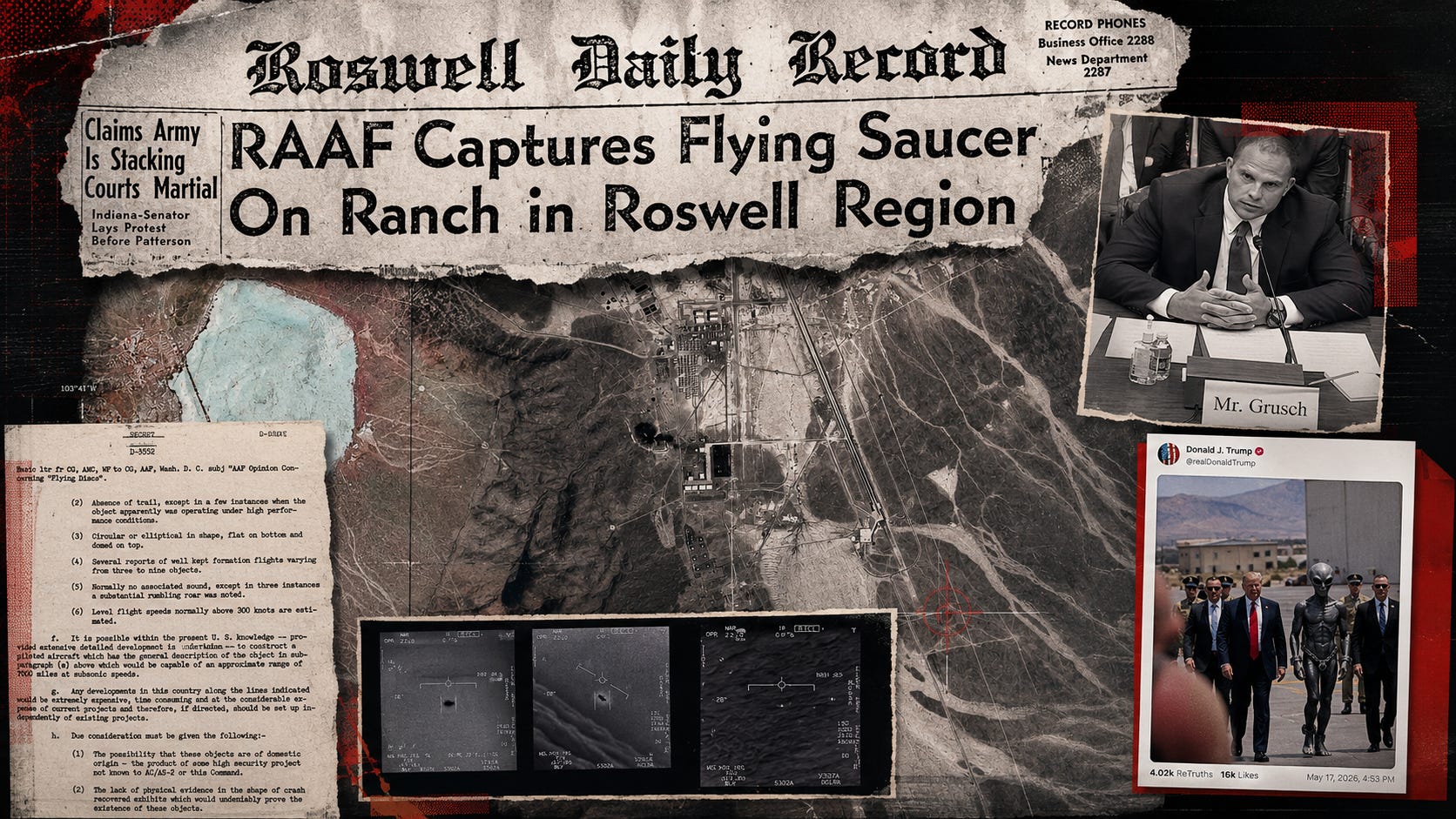
“Something’s happening here. What it is ain’t exactly clear.” — Buffalo Springfield
To anyone paying attention, it is clear that something big is afoot when it comes to UFOs and aliens.1
In less than a decade, the subject has migrated from the fringe into congressional hearings, prestigious scientific journals and even discussions of monetary policy.
This tectonic shift began in 2017 with the revelation of a secret Pentagon program to study anomalous aerial phenomena. It was a subject the military had not publicly admitted any interest in for decades. At the same time, details and infrared video leaked from a 2004 incident in which Navy personnel concluded they had encountered an object that moved in ways that defied the limits of human technology.
Then in 2023, things took a turn for the truly weird when a bipartisan group of six senators proposed a bill that would allow the federal government to assert eminent domain over “technologies of unknown origin” and “biological evidence of non-human intelligence.”
Days later, a former Pentagon intelligence official, David Grusch, testified to Congress that the U.S. government has engaged in a highly secretive, decades-long program to retrieve and reverse-engineer downed alien craft.
The following year, the Pentagon issued a report concluding that claims about reverse-engineering of “extraterrestrial technology” were unsupported.
That finding did not put the matter to rest.
Instead, since then, the strangeness has only intensified, as a growing roster of military veterans, former officials and government consultants have come forward to make statements that range from the cryptic to the fantastical.
The odder end of this spectrum includes claims made in the media early last year by an Air Force veteran that the government employs people with psychic abilities to summon alien craft. Then there was the spectacle last May of a consultant to past Pentagon UFO studies informing a congressman, at a briefing on Capitol Hill, that the alien species who pilot downed craft include “grays…Nordics … reptilians and insectoids.”
This February, when asked on a podcast about aliens, Barack Obama said, “They’re real. But I haven’t seen them. And they’re not being kept at Area 51.” Obama quickly walked back the comment,2 but the episode provoked a response from President Trump, who complained that his predecessor “took it out of classified information” and vowed to begin the rolling government release of UFO files that commenced this spring.
If you find all of this disorienting, you are not alone. The world has taken notice of the astonishing signals emanating from Washington.
Last fall, a journal in the portfolio of Nature published a paper purporting to provide statistical support for UFOlogists’ longstanding claims about a link between aerial anomalies and nuclear weapons. In January, an alumna of the Bank of England wrote to the central bank’s governor to warn him of the need to prepare for the potential of a financial crisis brought on by an official acknowledgement of alien life. In March, the consulting firm Deloitte included government revelation of non-human intelligence as one of two case studies of the kinds of “black swan” events that organizations worldwide should prepare for.
The official interest in UFOs and aliens has also made a cultural impact, helping to usher in a general mood of uncertainty about the border between the real and the fantastical.
Grainy UFO photos and videos — many of them obvious fakes — increasingly clog up social media feeds. An emerging ecosystem of podcasts and documentaries feeds millions of viewers a constant stream of content that treats the reality of aliens and reverse-engineering programs as established facts. Meanwhile, a growing subculture of “experiencers” who believe they can psychically summon and commune with aliens is gaining traction online.
There’s now a professionalized “Disclosure” movement — stacked with former officials and business elites — making the case that the government has no right to withhold fundamental truths about aliens and their technologies from humanity.
Gone, as a result, are the days when a UFO gathering implied a small group of misfits at a seedy Las Vegas hotel.
In one striking scene last fall, Ivy League academics and private equity investors were among those gathered on the shores of Italy’s Lake Maggiore for the annual conference of an alien-focused think tank. There, attendees took in a presentation from a group purporting to use the power of the human mind and a proprietary “electro-mechanical dog whistle” to attract and study UFOs.
So, what on Earth — or in the universe — is going on here?
The extent to which the ultimate explanations turn out to be alien intelligence, atmospheric phenomena, man-made drones, or a tangled mass of delusion, confusion, and disinformation remains to be seen.
Thus far, the Trump administration’s disclosure of UFO files has mostly just spurred more debate between skeptics and believers. And the announcement in June of a White House UAP Science Advisory Council suggests that these files will not put the matter to rest on their own.
But at least one thing is already clear: Whether or not it ends with aliens, the story of how we got to this strange juncture promises to be an extraordinary one.
I spent the last 15 years as a journalist, mostly in Washington, covering big, messy stories like the Trump-Russia saga, the Hunter Biden laptop SNAFU and the rise of crypto. I saw how existing institutions struggled to respond to those subjects and to controversial mysteries like Havana Syndrome and COVID’s origins.
These topics tended to share a few defining characteristics. They were politically fraught, technically complicated, and difficult to slot into existing categories — because they spanned worlds like politics, law, science, spycraft and corporate intrigue.
I also saw how the right mix of dogged reporting, thoughtful writing and open-minded perspective could overcome those challenges and get us closer to the truth.
The present UFO flap is more vexing and more intriguing than any story I’ve seen yet. So I’ve decided to launch a dedicated investigation of it. I’m optimistic that, at this particular moment, the right kind of inquiry can bring us closer to solving the mystery than we’ve been at any time in the 80 years since it first taunted humanity.
To kick it off, I’ve spent several months diving into decades of civilian UFO research, scouring declassified documents from governments around the world, surveying alternative media and interviewing two dozen people close to the subject — current and former officials, activists and researchers.
Those efforts permit a few preliminary findings:
The study of UFOs, and concern about them, have long been more serious than you’d think:
The subject was relegated to the fringe after a Pentagon-commissioned report dismissed its importance in 1969. But both before and since, scientists, intelligence analysts and senior military figures in the U.S. and allied nations have repeatedly concluded that the highest-quality UFO reports stem from real objects whose behavior defies apparent explanation.
While UFO research is just beginning to enter peer-reviewed scientific literature in any quantity, serious government and private efforts at scientific study of UFO sightings have existed continuously since the modern UFO phenomenon began in 1947.
The known body of physical evidence related to UFO sightings remains small relative to the high quantity of reports. But patterns exist in those eyewitness reports that are suggestive of a real, extraordinary physical phenomenon — as opposed to hallucinations or misidentification of banal objects. For example, a review of one historic dataset of about 900 eyewitness sightings shows a greater-than-7 percent incidence of apparent electromagnetic effects, like cars losing power, associated with UFO sightings.
And there are more recent cases that have stumped government investigators beyond the handful of famous incidents acknowledged in recent years. David Marler, an expert on triangular UFOs, told me that since 2024 investigators from the Justice and Defense departments have consulted him about sightings of triangular UFOs by “high-caliber witnesses” that could not be explained.
While a case can be made for presuming that some UFOs really do represent one or more exotic phenomena, the available evidence that humans are retrieving and reverse-engineering alien craft is much weaker:
Grusch has cited interviews with over 40 insiders in reaching his conclusion that the government really has retrieved and reverse-engineered alien craft. But public claims about reverse-engineering can largely be traced to a smaller group of about a dozen interconnected scientists and former officials, who have collaborated on research and advocacy efforts. (The Pentagon’s 2024 report denying reverse-engineering claims, which drew on non-public information, also traced the claims back to this group).
And there are plausible alternative explanations for famous crash-retrieval stories like Roswell.
This raises the possibility that the claims about U.S. possession of alien craft stem from misunderstandings and disinformation about real military programs, including those that retrieve and reverse-engineer human-made craft.
At the same time, the serious concerns demonstrated by people with access to classified information about these claims signal a need for additional transparency.
The UFO issue has broader implications for institutional legitimacy:
For existing institutions, the risks are twofold: One is the excessive mobilization of government, scientific, and philanthropic resources to explore claims that turn out to be nonsense.
The other is that alternative institutions discover, publicize and exploit the existence of non-human intelligence or other breakthroughs related to UFO anomalies while incumbents miss the boat.
In the 17th century, the failure of the Catholic Church to account for and integrate new scientific findings about the solar system undermined its legitimacy. Today, the UFO issue presents similar risks to existing institutions at a time when public trust in many of them has eroded.
The topic has also become a magnet for allegations of government malfeasance and New Age beliefs about consciousness. In fact, UFO lore has become so elaborate, and so divorced from mainstream understanding of reality, that it could form the foundations of an entire alternative belief system.
The current UFO flap need not lead to proof of alien life to produce a major technological shock – or even a shock in our understanding of reality:
It is possible that the anomalies detected by advanced military sensors in the 21st century will precipitate one or more scientific paradigm shifts.
It is also possible, as some observers speculate, that militaries have already exploited secret scientific breakthroughs to develop extraordinary technologies – and that some of the claims about aliens now surfacing publicly could stem from disinformation used to cloak these secrets.
A survey of journalistic inquiries and scientific claims in and around the UFO subject suggests several candidate breakthroughs. They include new understandings of time, gravity or the relationship between consciousness and the physical world; or new aircraft propulsion systems far outside of known human capabilities.
What follows is a beginner’s guide for anyone seeking to wrap their head around current UFO controversies and their sprawling ramifications.
Its purpose is to orient readers and provide a jumping off point for further investigation.
The guide traces the federal government’s evolving posture towards aerial anomalies; the rise of abduction reports; the subject’s migration into popular culture; the development of an elaborate reverse-engineering lore; the advent of the modern Disclosure movement; current scientific controversies and the consequences of this flap for our shared understanding of reality.
But first, it’s worth reviewing the genesis of the UFO phenomenon.
ONE SPOOKY SUMMER
“The phenomenon is something real and not visionary or fictitious.” — Air Force Gen. Nathan Twining
In future histories of American civilization, the middle months of 1947 are likely to cast a long shadow.
That summer, with the nuclear age and the Cold War still dawning, the federal government established the bureaucratic architecture that would cement the United States as a globe-spanning hegemon. At the same time, seemingly out of nowhere, the country found itself under siege from what witnesses described as a mysterious wave of saucer-shaped and totally alien craft.
Ever since, clandestine American power and the UFO mythos have both grown immensely and become inextricably intertwined.
On July 26, President Harry Truman signed the National Security Act of 1947. The law effected a reorganization of the national security state and established, among other things, the Air Force, the Central Intelligence Agency, and what would become the Department of Defense.
In the decades to come, the government that had unleashed the atom bomb would maintain an omnipotent mystique in the eyes of the world, and its own citizens. That was thanks in no small part to the secret military technology, covert operations, and air supremacy enabled by these new institutions.
But even these mighty organs of the American empire would be stymied by a new mystery in the skies.
Just a month before the law’s passage, Kenneth Arnold, a private aviator, reported a strange sight in the air over Washington State: nine objects, flying in formation, at approximately twice the speed of sound — far faster than any crewed aircraft that existed at that time — for about three minutes.
What did they look like? It’s worth noting that — thanks to some apparent confusion in early press reports — Arnold’s initial descriptions did not quite match the familiar shape that would soon become globally recognizable.
An article that appeared in the East Oregonian newspaper the next day, based on an interview with Arnold, described “saucer-like aircraft.” But in a radio interview two days after the sighting, Arnold recounted, “They looked something like a pie plate that was cut in half, with a sort of a convex triangle in the rear.”
In a statement to military investigators, Arnold described “saucer like objects” that “appeared to be completely round” when reflecting sun, though an illustration he provided alongside his statement made clear that they were irregularly shaped.
Arnold later said that he had used the term saucer not to describe the objects’ shape, but their undulating flight pattern: “like a saucer if you skip it across the water.”
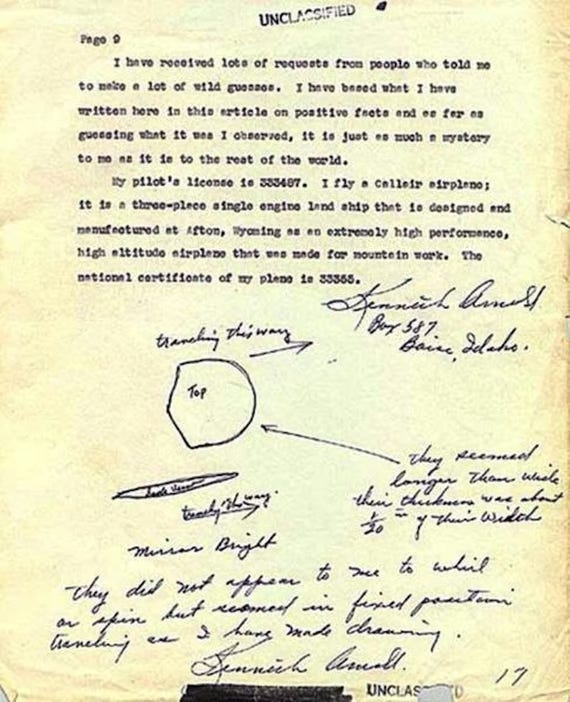
An account and notes provided by Arnold to military investigators (Wikimedia Commons)
But the term “flying saucer” made headlines, and the familiar image of a saucer-shaped spacecraft was stamped indelibly into the collective consciousness.3
Arnold’s report kicked off a wave of UFO sightings, numbering close to a thousand, over North America in the weeks that followed.
The most consequential report, though, was of something found on the ground in New Mexico early the next month. There, a rancher came across unusual debris, including metallic foil, strewn on a property outside the city of Roswell. Believing it could be wreckage from one of the flying disks that had been all over the news, the rancher contacted local authorities, who turned him over to officials at the Roswell Army Air Field. On July 8, the base’s public information officer issued a press release announcing the recovery of a flying disc.
The announcement set off shockwaves, but almost immediately the military, in the person of Brigadier General Roger Ramey, said the flying disc identification was a mistake, and offered a more mundane explanation: the debris amounted to a pile of foil, rubber and wooden sticks from a downed weather balloon.
Public curiosity was satisfied. Ramey, it seemed, had closed the case.
It wouldn’t last. Interest in both Roswell and flying discs was here to stay.
The Age of the UFO had dawned.
THE MEN IN BLACK
“What you think you saw, you did not see” — Will Smith, “Men in Black” (1997)
The flying saucer wave presented American officials with two problems: their own consternation and the need to manage public perception.
In September of 1947, Air Force Lieutenant General Nathan Twining sent a memo on the UFO wave to top brass concluding that “The phenomenon is something real and not visionary or fictitious.”
Despite Arnold’s initial report of an irregular craft, the sightings analyzed by Twining were of objects that were very much saucer-shaped: “Circular or elliptical … flat on bottom and domed on top.”
The memo noted the lack of physical evidence for the objects’ existence, while hypothesizing that they might employ top-secret American or foreign technology, perhaps nuclear propulsion, that accounted for their extraordinary speed and maneuverability.
Twining concluded by recommending a detailed study of the matter.
What followed was 20 years of on-again-off-again Pentagon initiatives — under the names Projects Sign, Grudge and Blue Book — to study UFO sightings.
The Air Force concluded that most sightings it investigated were caused by misidentification of natural phenomena – like ball lightning, birds and the planet Venus – or man-made objects, like satellites. Air Force investigators also wrote off some reports as hoaxes.
A small minority of cases eluded official explanation, while witnesses and civilian UFO researchers sometimes rejected the ordinary explanations proffered by the Air Force. But the federal government had reason to downplay any lingering mystery.
After a spike in UFO reports in 1952, which included a summer wave in Washington, D.C., the CIA became concerned that the high volume of civilian UFO reports flooding the federal government could overwhelm air defense systems and that the Soviet Union could exploit UFO hysteria for psychological warfare purposes.
In 1953, it convened the Robertson Panel, chaired by physicist Howard Robertson, to address public concerns. The panel’s report found no basis for concluding that UFO reports were caused by extraterrestrial craft or foreign weapons systems, and recommended more proactive debunking of UFO cases in order to deter public interest in the subject.
Even as the CIA signalled a desire to deemphasize UFOs, the Air Force investigation open at that time, Project Blue Book, continued well into the next decade. Then, in 1966, the Air Force commissioned a study of its findings from University of Colorado physicist Edward Condon. He came back two years later with the conclusion that further government study was not likely to bear scientific fruit. In December 1969, on the strength of the Condon Report, the Air Force shuttered Blue Book.
This outcome failed to satisfy the sizable community of UFO researchers that had sprouted up in the years since Arnold’s sighting.
Notably, official government dismissals also failed to satisfy some well-placed government officials.
“Behind the scenes, high-ranking Air Force officers are soberly concerned about the UFOs,” retired vice admiral R.H. Hillenkoetter told United Press International in February 1960. “But through official secrecy and ridicule, many citizens are led to believe the unknown flying objects are nonsense.”
Hillenkoetter, who had served as the CIA’s first director upon its establishment in 1947, was so unimpressed by official debunkings that after leaving government service, he joined the board of the then-leading civil society group for UFOlogists, the National Investigations Committee on Aerial Phenomena.
Even more remarkable, perhaps, was the case of astronomer Allen Hynek, who served as a scientific adviser to the Pentagon’s early UFO investigations. Hynek was the source of many of the debunking explanations the military offered for unusual aerial sightings, such as airplanes, weather balloons, and in one iconic episode in Dexter, Michigan, “swamp gas.”4
But far from being satisfied that the issue was settled, Hynek grew increasingly frustrated with an Air Force bureaucracy he perceived as determined to wave away all anomalous reports at the expense of scientific rigor.
After the expiration of his military advisory role in 1969, Hynek devoted the remainder of his career to further UFO investigation, an endeavor that alienated him from many of his scientific colleagues.
Of course, by the end of the sixties, alienation was going around. In the age of Richard Nixon and the Vietnam War, the United States entered a period of cynicism, marked by distrust of government.
Since the spooky summer of 1947, the post-war security apparatus had spawned a growing number of “black programs.” These military and intelligence projects, modeled on the Manhattan Project, were subject to strict classification, compartmentalization and even misdirection designed to obscure their true purpose.5
By the ’70s, denizens of this shadowy region of government had started referring to it as the “Black World,” a dark place where powerful new technologies and covert operations dwelled under a veil of deception.
In this milieu, the established reality of government agents like Hynek, who did show up at the sites of odd sightings, gave way to visions of more menacing figures. The Men in Black, agents sent by the powers that be to cover up the truth about aliens, entered the zeitgeist.
Through them, the UFO story crystallized in the popular imagination into a parable of the government’s determination to conceal the true nature of reality from its own citizens.
THE LORE
“I’ve often felt that dreams are answers to questions we haven’t yet figured out how to ask.” — Agent Fox Mulder, The X-Files
The end of Blue Book banished UFOs from respectable discourse. But by 1969, it was too late to dislodge the subject from its place in the popular imagination and among a thriving subculture of true believers.
In the final decades of the 20th century, a mishmash of documented sightings, rumors and theories gelled into a unified account of the UFO phenomenon. Referred to in UFO circles as “the Lore,” it has become something of an unofficial founding mythology for the Black World.
While there is no single, canonical version of the Lore, the best versions of it weave the disparate elements of the UFO subject into a surprisingly coherent and elaborate story of a massive government effort to conceal the existence of aliens and study their technology.
To do that, the Lore also had to account for a new aspect of the UFO phenomenon that was arguably more baffling than aerial sightings or tales of downed craft: abduction experiences.
An early template for these experiences was set by a New Hampshire couple, Barney and Betty Hill, who reported a bizarre encounter with not-quite-human entities while driving home from Niagara Falls one September night in 1961. As they later recounted it, the Hills saw an otherworldly craft in the sky. It then, they said, approached them and hovered, revealing short, gray-skinned humanoid occupants, who communicated telepathically and took the couple onto their craft for medical examinations.
In the years since, experiences similar to the Hills’ have been reported with remarkable frequency.6
Early abduction reports caught the attention of Jacques Vallee, a dashing French astronomer. As a young scientist, he had collaborated with Hynek on UFO research after the latter left Air Force employment. Vallee went on to serve as the inspiration for the French scientist Claude Lacombe in Steven Spielberg’s Close Encounters of the Third Kind.
In his 1969 book Passport to Magonia, Vallee, now 86, wrote that modern abduction reports shared important characteristics with more ancient stories, such as traditional folklore about fairyland. One commonality was a tendency for people to report being taken to surreal environments for what felt like a relatively short period, only to return to their normal lives and find that much more time had elapsed in the real world than they could account for.
(In the face of such vexing accounts, it became increasingly common to hypothesize that alien beings came from the future, other dimensions, or even more obscure realms, rather than a far-off star system.)
The most influential abduction story may come from the horror writer Whitley Strieber’s 1987 book “Communion: A True Story.” In it, the author recounts how the onset of a vague sense of unease led him to undergo hypnosis and unearth memories of an alien abduction experience. Strieber argued that the presence of physiological after-effects, including a lesion near his ear, ruled out mundane explanations, like a hallucination or other purely mental cause.
The book’s cover — featuring an illustration of a humanoid figure with gray skin, large black eyes and thin lips — has become one of the most iconic depictions of an alien.

One of the 20th century’s most influential book covers depicts the familiar alien type now called a “gray.”
Strieber’s book helped usher canonical abduction experiences into the mainstream of American culture. And as tales of such experiences proliferated, a Harvard psychiatrist, John Mack, decided in the early 1990s to investigate.
At the outset of his inquiry, as Mack later recounted, he visited an old family friend, the historian of science Thomas Kuhn.
Kuhn had written “The Structure of Scientific Revolutions,” a landmark 1962 book in which he argued that scientific theory moves forward through a recognizable, recurring pattern: Within a scientific subfield, when scientists encounter anomalous observations that are not well explained by current theories, they attempt to reconcile them within the subfield’s prevailing framework, called a paradigm.
Eventually, the anomalies accumulate to a point that cannot be reconciled with prevailing frameworks, precipitating a crisis in the scientific subfield. The crisis is resolved when a scientist, often someone young or marginal to the subfield, posits a new theory that better accounts for the anomalies. For political and practical reasons, many existing practitioners reject the new theory, but it eventually wins out as incumbent scientists die out and are replaced by a new generation.
The book used the term “paradigm shift” to describe this process.
Kuhn, Mack recalled, encouraged him to approach abduction experiences with an open mind and to ignore objections to the project made in the name of institutional science, which Kuhn believed had grown too dogmatic and unwilling to explore phenomena that lay outside the material world.7
Mack went on to find several recurring patterns in abductees’ reports, including experiences of passing through walls, immobilization, invasive medical procedures, and gaps in conscious memory.
He found that “experiencers” did not, in general, appear to be mentally ill, and concluded that the abduction phenomenon was not well explained by existing psychiatric theory. He suggested it might even present dilemmas for the materialist understanding of reality assumed by Western science.
Mack’s suggestion that abduction experiences may be caused by some external, exotic phenomenon scandalized many of his colleagues at Harvard, who also expressed concerns about elements of his methodology, including the use of hypnosis. In 1994, the university’s medical school opened an investigation into his work, though the process ultimately reaffirmed his academic freedom.
****
As American culture digested alien abductions, it also undertook a reconsideration of the original UFO crash tale following the publication of a sensational book about Roswell.
For 30 years, the episode had barely been mentioned in UFO lore. But in the 1980 book The Roswell Incident (and other interviews around the time of the book’s publication), Jesse Marcel, the Army Air Force intelligence officer who originally responded to the crash report, shared new details. He described the foil material he recovered as “nothing made on this Earth” and said the debris bore strange hieroglyphic markings.
The book also contained claims by William Brazel Jr., the son of the rancher who initially found the debris, that his late father had been detained by the military and sworn to secrecy, fueling suspicions that Roswell had been a coverup.
In the years that followed, some people close to the Roswell incident and their surviving relatives began to make public claims about alien bodies. In one case, local mortician Glenn Dennis said in 1989 that he received a call from the air base at the time of the crash inquiring about child-sized caskets.
The clamor caught the attention of Steven Schiff, a Republican congressman from New Mexico, whose inquiries prompted the Air Force to re-investigate the episode. It published a report in 1994 concluding that those who smelled a coverup at Roswell were… correct. But what was being covered up, the Air Force said, was that the wreckage near Roswell came from a top-secret effort, called Project Mogul, to spy on the Soviets using high-altitude balloons.8
This explanation was not enough to banish aliens from the zeitgeist. Even as the Pentagon batted down rumors about Roswell, the deserts of the Southwest had given the Lore a new landmark to mythologize.
In 1989, a local television reporter in Las Vegas, George Knapp, landed one of the strangest exclusives in the history of American journalism: An anonymous source, later revealed to be technician Bob Lazar, claimed to be involved in the reverse-engineering of alien craft at Area 51, a secret Air Force facility north of Las Vegas.9
Since then, no hard evidence has emerged of alien craft at Area 51. But the previously obscure facility joined Roswell as an icon of government-on-alien skullduggery in countless movies and shows, such as The X-Files.
It also took its place in the Lore.
In the twilight zone between established fact and acknowledged fiction, UFOlogy was, by the ’90s, formulating its complex alternative history of the post-war world. The Lore was informed by purported insider information10 and purported leaks of secret documents,11 as well as the public accounts of countless alleged witnesses and abductees. And it offered a grand unifying theory of the relationship between anomalous phenomena and Black World secrecy.
Versions of the Lore, as it exists today, often include the following: UFOs came to public attention in the aftermath of World War II because the use of atomic weapons attracted interest from an alien intelligence. The alien craft achieved incredible feats of speed and maneuverability by manipulating gravity. They were steered telepathically, which is also how the aliens communicate with humans.
Roswell and other crash stories long considered debunked by the mainstream were true. And the brightest minds American civilization could muster, like Vannevar Bush and Edward Teller, inventor of the hydrogen bomb, had secretly worked to reverse-engineer alien tech, at Area 51 and elsewhere, in a top-secret effort called “The Program.”
These efforts met with some success: Alien technology inspired important 20th-century breakthroughs, including the transistor and fiber optics (The “memory metal” found at Roswell inspired the invention, years later, of nitinol, a nickel-titanium alloy with shape memory).
To maintain a veil of secrecy, the alien technology was treated as “restricted data” under the Atomic Energy Act of 1946, a move that was legally justified by the radiation it emits. Special secrecy provisions in the law complicate the power of the president to declassify alien tech, while giving the Department of Energy jurisdiction over much of the program. The CIA, of course, was involved, as was the Air Force.
Somewhere along the way, the best material fell into the hands of one or more defense contractors, further stymying oversight by elected officials.12
This version of 20th century history remained marginal until the summer of 2023, when Grusch testified to Congress that the broad outlines of the Lore, and many of its particulars, were not only true, but constituted a pressing matter of national security.
Grusch also offered support for more recent elements of the Lore.
He testified that his visibility into a large number of compartmentalized programs allowed him to see what their participants couldn’t. In the interests of secrecy, the reverse-engineering effort had become “stove-piped” and ineffective. In stark contrast to the collaborative and effective Manhattan Project, teams worked in isolation from each other, hindering their ability to make progress.
This is especially alarming, Grusch testified, because China and Russia are engaged in their own alien reverse-engineering efforts that threaten to overtake our own.
At least as far as the Lore was concerned, the UFO arms race had officially gone global.
WHAT IN THE WORLD?
“The existence of the phenomena is undisputed” — Former Brazilian defense secretary Aldo Rebelo, discussing Brazilian Air Force UFO encounters, June 2026
Alleged arms race aside, the UFO phenomenon is indeed a global one.
A common misconception among skeptics holds that UFO sightings are isolated to the U.S., the result, perhaps, of a military with a lot of secret programs to hide combined with a populace that is both more naive and more paranoid than others.
In fact, UFO sightings, the belief that they are caused by aliens, and even the belief that the U.S. is reverse-engineering alien craft have long existed among both the governments and the people of the world.
As early as 1950, Wilbert Smith, an official with Canada’s Department of Transport, authored a since-declassified memo about American UFO efforts based on “discreet inquiries” made through staff at the Canadian embassy in Washington. He concluded, “Flying saucers exist”; “The matter is the most highly classified subject in the United States Government, rating higher even than the H-bomb”; and “Their modus operandi is unknown but concentrated effort is being made by a small group headed by Doctor Vannevar Bush.”
“I was further informed that the United States authorities are investigating along quite a number of lines which might possibly be related to the saucers such as mental phenomena,” he wrote, “and I gather that they are not doing too well since they indicated that if Canada is doing anything at all in geo-magnetics they would welcome a discussion with suitably accredited Canadians.”
Decades later, after the memo became public, the physicist Robert Sarbacher, a Pentagon consultant during the early Cold War, outed himself as one of the sources for it.
In a 1983 letter to UFO researcher William Steinman, Sarbacher elaborated on his recollections. “Certain materials reported to have come from flying saucer crashes were extremely light and very tough,” he wrote. “I am sure our laboratories analyzed them very carefully. There were reports that instruments or people operating these machines were also of very light weight, sufficient to withstand the tremendous deceleration and acceleration associated with their machinery. I remember in talking with some of the people at the office that I got the impression these ‘aliens’ were constructed like certain insects we have observed on earth, wherein because of the low mass the inertial forces involved in operation of these instruments would be quite low. I still do not know why the high order of classification has been given and why the denial of the existence of these devices.”
Sarbacher told Steinman he had no firsthand knowledge of any UFO activity, and was only relaying what he had heard and seen in internal reports.
It is possible that Sarbacher had been exposed to disinformation designed to conceal the existence of Project Mogul or other secret U.S. programs. But he would not be the last person in a sensitive government position to conclude that reverse-engineering rumors were true.
In 1971, Harry Turner, an intelligence analyst for the Australian government, authored a since-declassified assessment, in which he concluded that the Robertson Panel was a CIA feint. “By erecting a facade of ridicule, the U.S. hoped to allay public alarm,” he wrote, “and act as a cover for the real U.S. programme of developing vehicles that emulate UFO performances.”13
Turner argued that efforts to accelerate gravity research, undertaken by the U.S. government starting in the 1950s, made little sense in the context of existing theories of physics. They should instead, he wrote, be understood as an effort to reverse-engineer UFOs, which were thought to operate by means of gravity manipulation.
****
Foreign officials did not just have to worry about what Americans had seen and what the CIA knew. They had their own airspace to worry about: UFOs have been sighted in the skies over every inhabited continent, vexing governments around the world.
The Belgian Wave, for example, shook that corner of Western Europe for months from late 1989 into early 1990. Thousands of citizens reported aerial sightings that clustered around a peculiar pattern: large, black triangular craft that appeared to have lights on their undersides, hover silently at low altitudes and accelerate faster than known human craft.
The wave was never explained, though skeptical scholars have proposed that some sort of mass delusion played a role.
Among the points in favor of the skeptics is that the most famous image to emerge from the wave was exposed as a crude hoax.
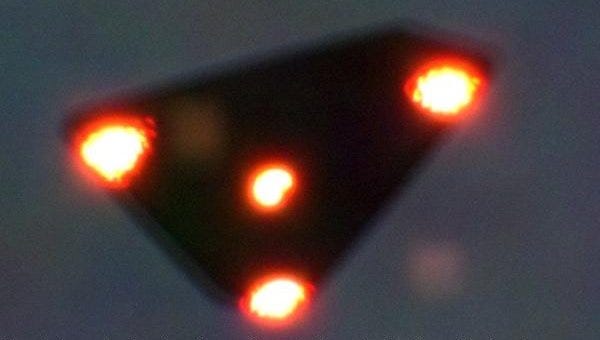
The creator of this image initially claimed to have captured a shot of a Belgian Wave craft. He later said it was a slab of polystyrene and some light bulbs.
Despite the prevalence of hoaxes, Belgians’ neighbors in France have long taken the UFO mystery seriously.
In 1977, at a time when U.S. inquiries were officially dormant, the French government established its own UFO investigation office, now called GEIPAN.
By placing the office inside the national space agency, rather than the military, the French positioned UFOs more as a scientific question than as a potential threat.
The office has documented a handful of episodes of particular interest to UFOlogy. In one case from January of 1981, a man in southeastern France reported seeing a round, gray craft, about 8 feet in diameter, with no visible means of propulsion, land briefly on his property before rising vertically and speeding out of sight. According to its report, GEIPAN took samples of soil and alfalfa plants from the site of the alleged landing, which appeared to contain skid marks. The report found that alfalfa plants near the site of the alleged landing showed unexplained damage to their leaves — including a reduction in chlorophyll – and hypothesized that exposure to an “intense electric field” could be responsible.
“A significant and unusual phenomenon occurred that day,” GEIPAN concluded, “and the investigation failed to determine its origin.”
An extraordinary report published in 1999 by COMETA, a French UFO group led by scientists and retired military leaders, was more conclusive. It asserted “the almost certain physical reality of completely unknown flying objects with remarkable flight performances and noiselessness, apparently operated by intelligent [beings].” The report concluded that, based on available information, the most likely explanation for the UFO phenomenon was “extraterrestrial visitors.”14
In an appendix on Roswell, the report’s conclusions go even further. “The disappearances of files and the Air Force’s clumsy attempts at explaining [the incident] show that U.S. military personnel are hiding something important that occurred at Roswell in July 1947,” the report states. It opines that the Air Force report attributing the debris at Roswell to Project Mogul smacks of disinformation intended to conceal an even more sensitive truth. “The hypothesis of an extraterrestrial vessel that is supported by quality testimonies cannot be dismissed,” it concludes.
While some veterans of the French defense establishment suspected the Americans of using disinformation to conceal the reality of downed spacecraft, the reverse is certainly true: American officials at times have concocted UFO stories to conceal more earthly secrets.
In one notorious case from the 1980s, when a civilian engineer started to investigate unusual activity around Kirtland Air Force Base, an Air Force official encouraged the man’s belief that he was monitoring the activities of aliens, rather than the NSA.
More recently, the Wall Street Journal reported last year on a practice, allegedly widespread for decades within the Air Force, in which commanders overseeing secret research programs were shown an image of a flying saucer and falsely told their project was part of an effort, codenamed “Yankee Blue,” to reverse-engineer the craft. The Journal characterized the alleged practice as a hazing ritual.
Believers in an actual alien reverse-engineering program greeted the Journal article with skepticism, and Grusch has said his findings were not based on a misunderstanding of hazing rituals. The Journal cited a Pentagon spokeswoman who said the Defense Department expected to release a report detailing the practice by the end of 2025. But no such report has materialized, and the Pentagon did not respond to a question about when and whether to expect it.
Just how much UFO lore ultimately originates from government disinformation is a question that may never be answered satisfactorily.
PANDORA’S BOX
“We ended up coming progressively to the conclusion that there’s not just smoke here, there’s fire.” — Kirk McConnell, career staffer on the Senate intelligence and armed services committees
Inside the United States, UFOs remained safely quarantined to film, television and a marginal subculture of UFOlogists until December 2017, when the New York Times and POLITICO ran stories revealing the existence of a secret Pentagon program to investigate them.
The Times story featured footage from a 2004 encounter between Navy fighter jets based on an American aircraft carrier, the Nimitz, and what appeared to be a tic-tac-shaped object that — without any visible means of propulsion — accelerated and maneuvered in ways that far exceeded the capacity of any known human technology.
After an initial flurry of interest, the subject receded, in mainstream public discourse, to the status of an intriguing, lingering mystery.
Progress towards a solution was desultory. Details of a couple of similar incidents trickled out. Senior officials made some surprisingly frank statements, including former CIA director John Brennan. (“Some of the phenomena we’re going to be seeing continue to be unexplained,” he said, during a 2020 podcast appearance, “and that could involve some type of activity that some might say constitutes a different form of life.”)
And the Pentagon convened a UAP Task Force, then opened the All-Domain Anomaly Resolution Office, AARO, to examine odd incidents and issue public reports.
Then in 2021, the Office of the Director of National Intelligence released a preliminary assessment. “Most of the UAP reported probably do represent physical objects given that a majority of UAP were registered across multiple sensors,” it found. “In a limited number of incidents, UAP reportedly appeared to exhibit unusual flight characteristics. These observations could be the result of sensor errors, spoofing, or observer misperception and require additional rigorous analysis.”
While acknowledging continued uncertainty, the government had, it seemed, successfully contained the issue within a bureaucratic framework.
But behind the scenes, a loose-knit group of officials and scientists in and close to the government had opened a Pandora’s box. Secrets, rumors and accusations from the Black World continue to spill out of it to this day.
Several of this group’s members were involved in the Pentagon UFO program revealed in 2017, and they maintain that elements within the Black World are covering up the existence of advanced, non-human intelligence.
Two of them, former Deputy Undersecretary of Defense for Intelligence Chris Mellon and Pentagon official Luis Elizondo, had reportedly helped set in motion the 2017 Times story by tipping off a journalist to the existence of the tic-tac video.
Other members of the group include engineer Hal Puthoff and his longtime collaborator, astrophysicist Eric Davis.
The driving force behind much of the pair’s work has been Robert Bigelow, an aerospace magnate. Bigelow has sponsored much private UAP research, and he convinced Harry Reid to appropriate the funding for the Pentagon UFO program whose existence was revealed by the Times and POLITICO.
Skeptics note the association of several members of this group with fringe activities and beliefs.
Bigelow for years owned Skinwalker Ranch, a property in Utah where visitors, some of them involved in UAP research, have claimed to witness a variety of bizarre sights, including mutilated cattle and oversized wolves.
Before his turn as a UFO guru, Puthoff led Cold War era “psychic spies” research for the military and the CIA, shaping programs that purported to rely on the extrasensory abilities of “remote viewers” to gather intelligence on the Soviet Union.
Tim Gallaudet, a retired Navy rear admiral who endorses the non-human intelligence explanation for UAP, has publicly stated that his daughter “can see spirits,” likening her to a medium who can “tap into…the other side.”
(There’s also the issue of false positives: In 2024, after presenting a blurry photo of what he described as a “mothership” at a gathering in Philadelphia, Elizondo was forced to back off the claim when a group of online researchers traced the photo to a Facebook group and suggested it actually depicted a chandelier.)
The group’s role in the elevation of UFO controversies did not end with 2017’s press revelations.
Grusch has testified that, in 2019, while working on a Pentagon UAP investigation, he was tasked with compiling a comprehensive list of secret military programs. It was that assignment, he testified, that eventually led to his startling conclusions about alien technology.
Over lunch in Austin last fall, Davis told me that he and Puthoff briefed Grusch early on in his investigation inside a secure facility in Colorado Springs in March 2020 about the alleged existence of a government program to reverse-engineer UFOs.
Davis said that he provided Grusch with a roadmap for investigating the claim, including a list of people to talk to.
(A second person familiar with the investigation, speaking on the condition of anonymity, said that Puthoff and Davis provided Grusch with a mix of “interesting leads” and information that Grusch later determined to be false. The person said that Grusch did not rely on them as core witnesses.)
Three years later, Grusch burst into public view with his spectacular findings.
At the same time, six senators — Chuck Schumer, Mike Rounds, Marco Rubio, Kirsten Gillibrand, Todd Young, and Martin Heinrich — proposed the UAP Disclosure Act, an amendment to the National Defense Authorization Act that included the following provision: “The Federal Government shall exercise eminent domain over any and all recovered technologies of unknown origin and biological evidence of non-human intelligence that may be controlled by private persons or entities in the interests of the public good.”15
Two weeks after that, the public got a taste of the thinking behind this mystifying proposal when Grusch delivered whistleblower testimony to Congress.16
At a House Oversight Committee hearing, he offered an astounding account: He testified that his efforts to compile a comprehensive list of secret military programs caused him to stumble upon claims that the government has been retrieving and attempting to reverse-engineer downed alien craft for decades. Grusch said he concluded those claims were true after he spent four years interviewing dozens of witnesses about them. Grusch also testified that the government had recovered non-human “biologics” and that people had been harmed in order to protect the secrecy of these activities.
Kirk McConnell, a career Senate staffer who investigated the matter, later said in a podcast appearance17 that, behind the scenes, the inquiry into Grusch’s claims “led to other people coming to Congress and telling their stories, which were riveting and credible.”
McConnell specified that these new witnesses were not from the well-known group of figures associated with prior Pentagon UFO programs (such as Elizondo, Davis and Puthoff).
“These are people with high-level clearances, positions of authority in the intelligence community and the Defense Department,” he said of the additional witnesses, “and no reason to be fabricating things.”
“We ended up coming progressively to the conclusion,” McConnell said, “that there’s not just smoke here, there’s fire.”
But in officially shooting down the crux of Grusch’s testimony the following February, the Pentagon’s UFO office, AARO, largely attributed claims of an alien reverse-engineering program to “circular reporting from a group of individuals who believe this to be the case, despite the lack of any evidence.”
AARO’s report said that many of the military personnel it interviewed to get to the bottom of Grusch’s claims described real Pentagon programs that they mistakenly believed involved alien technology. The report also found that in 2021 a program run by an unnamed intelligence agency really did expand its mission to include reverse-engineering of alien craft, but the report said the program never found any alien technology and was closed.
The report attributed the expansion of the program’s mission to six unnamed members of the interconnected group of actors it blamed for ginning up the reverse-engineering narrative.18
Grusch did not back off his claims in the wake of the Pentagon’s findings (or a report that he had been committed to a mental health facility in 2018 after expressing suicidal thoughts). Instead, in an unprecedented move for a congressional whistleblower, he joined the House investigation as a staffer for Rep. Eric Burlison, a Missouri Republican, in April of 2025.
A few months later, the House Oversight Committee held a hearing at which Air Force veteran Dylan Borland testified that he had direct knowledge of UAP programs. Borland also testified that he personally observed a silent, 100-foot-long triangular UFO that got within 100 feet of him, interfered with his cellphone and rapidly accelerated skyward at Langley Air Force Base in Virginia in the summer of 2012.
Borland’s description of a silent triangular UFO that exhibits extraordinary acceleration is similar to many sightings from the Belgian Wave. The description also matches several of the defining characteristics of a much broader set of triangular UFO sightings, dating back to the 1950s, as set out in “Triangle UFOs: An Estimate of the Situation,” a 2013 book by New Mexico researcher David Marler. Marler’s list of 10 primary characteristics includes silent flight, low-altitude flight, and rapid acceleration.
Marler told me that in the last two years, investigators with both the Defense Department and the Justice Department have consulted him and his book. “They have triangle cases that they simply can’t resolve,” he said.
Marler said federal investigators did not divulge the details of the cases and asked him not to name the specific agencies examining them. But he said investigators took the matters seriously. “They kept saying, ‘These are high-caliber witnesses that we’re interviewing,’” Marler recalled, saying that he took that to likely mean trained military personnel.
The Justice Department did not respond to a request for comment. A Pentagon spokeswoman, citing department policy, wrote in an email, “We do not comment on the details of conversations between AARO and external partners.”
DISCLOSURE
“It’s time to find out what the truth really is that’s out there. The American people—and people around the world—want to know, and they can handle the truth.” — Former White House chief of staff John Podesta, 2010 (from “UFOs: Generals, Pilots, and Government Officials Go on the Record” by Leslie Kean)
The dramatic escalation of government interest in UFOs and the more incredible elements of the Lore has unleashed a full-fledged movement for government disclosure of UFO secrets, complete with activists working Capitol Hill, and as of this summer, a Steven Spielberg movie, “Disclosure Day.”
The roots of this movement can be traced to the ’90s, when the term “Disclosure” gained currency as a byword for the government coming clean about secret UFO knowledge. Notably, in 1993, physician-turned-UFOlogist Steven Greer founded the Disclosure Project to facilitate UFO whistleblowing by government insiders, helping to cement the concept in UFOlogy even as it remained fringe.
In the wake of Grusch’s 2023 testimony, Disclosure has taken on a life of its own, as a slew of insiders have taken advantage of a wide-open media landscape to go public with their own claims about UFOs and aliens.
Not long after Grusch’s testimony, another former Pentagon official involved with the military’s UFO research, Jim Lacatski, claimed in a podcast appearance that the government not only possessed a UFO, but had accessed its interior. Then Elizondo, the former Pentagon official who facilitated the New York Times’ blockbuster 2017 scoop, affirmed Grusch’s claims about crash-retrieval and reverse-engineering in his own congressional testimony.
Shortly before his death last year, Harald Malmgren, a former high-ranking U.S. trade official, said that CIA officer Richard Bissell briefed him on “otherworld technology” in the 1960s and that he personally handled debris from a UFO inadvertently downed by a 1962 U.S. nuclear test, Bluegill Triple Prime.19
In January 2025, Air Force veteran Jake Barber began claiming in media appearances that he personally participated in the crash retrieval program, and that the military employed people with psychic abilities as part of its efforts to understand UFOs.
Speaking to Joe Rogan last May, Puthoff estimated that the U.S. possesses “more than 10” downed alien craft. That same day, his longtime collaborator, astrophysicist Eric Davis, appeared at a briefing on Capitol Hill. There, Davis explained to Burlison that the pilots of these craft “are typically the multiple species people are familiar with: the grays, the Nordics. People have talked about reptilians and insectoids. It’s not that they’re reptilian or insectoid. It’s that they resemble… a reptile or an insect-type humanoid.”20
Meanwhile, a constellation of polished groups has formed to lobby for Disclosure and prepare the world for its presumed consequences. They include the Disclosure Foundation, a nonprofit headed by a veteran of McKinsey that pushes for government transparency and boasts professors from Harvard and Yale on its advisory board.
Danny Sheehan, an attorney who represented John Mack in his clash with Harvard’s faculty, has launched Citizens for Disclosure to organize grassroots activity.
Ryan Graves, a former Navy fighter pilot who has testified to Congress about UFO encounters, has founded Americans for Safe Aerospace to encourage military pilots to share their own encounters. It counts former Harry Reid chief of staff Susan McCue among its advisers.
There’s also the Sol Foundation, a think tank whose board is headed by Stanford medical professor Gary Nolan. It describes its goal as “to prepare all areas of society—government, academia, the private sector, and religious and other civil institutions (to name a few)—for the changes that increased public awareness of UAP will bring.”
UFO-themed media is also taking off.
“Age of Disclosure,” a documentary released last fall that features interviews with Rubio, Gillibrand and other senior officials, purports to shine a light on the government’s alien reverse-engineering efforts. In it, Elizondo, Puthoff and Davis lay out their theory of alien anti-gravity technology based on patterns in UFO sightings.21 It debuted as the most-purchased movie on Amazon.
On the podcast Weaponized, George Knapp, the Peabody Award-winning journalist who first interviewed Bob Lazar about Area 51, and his co-host Jeremy Corbell, feature a heavy dose of military veterans along with leaked videos of purported military UFO encounters.
There’s also American Alchemy, hosted by Jesse Michels, a former venture investor with Peter Thiel’s family office and aficionado of speculative science. Michels regularly draws millions of viewers with episodes that delve into UFO Lore and the speculative science around it.
In one sign of this ecosystem’s influence, Burlison invited Sam Gerb — a UFO investigator who publishes his speculative research on YouTube — onto his official congressional podcast in March. On the podcast, Gerb outlines his theory of how Black World operators are funding and hiding reverse-engineering efforts.
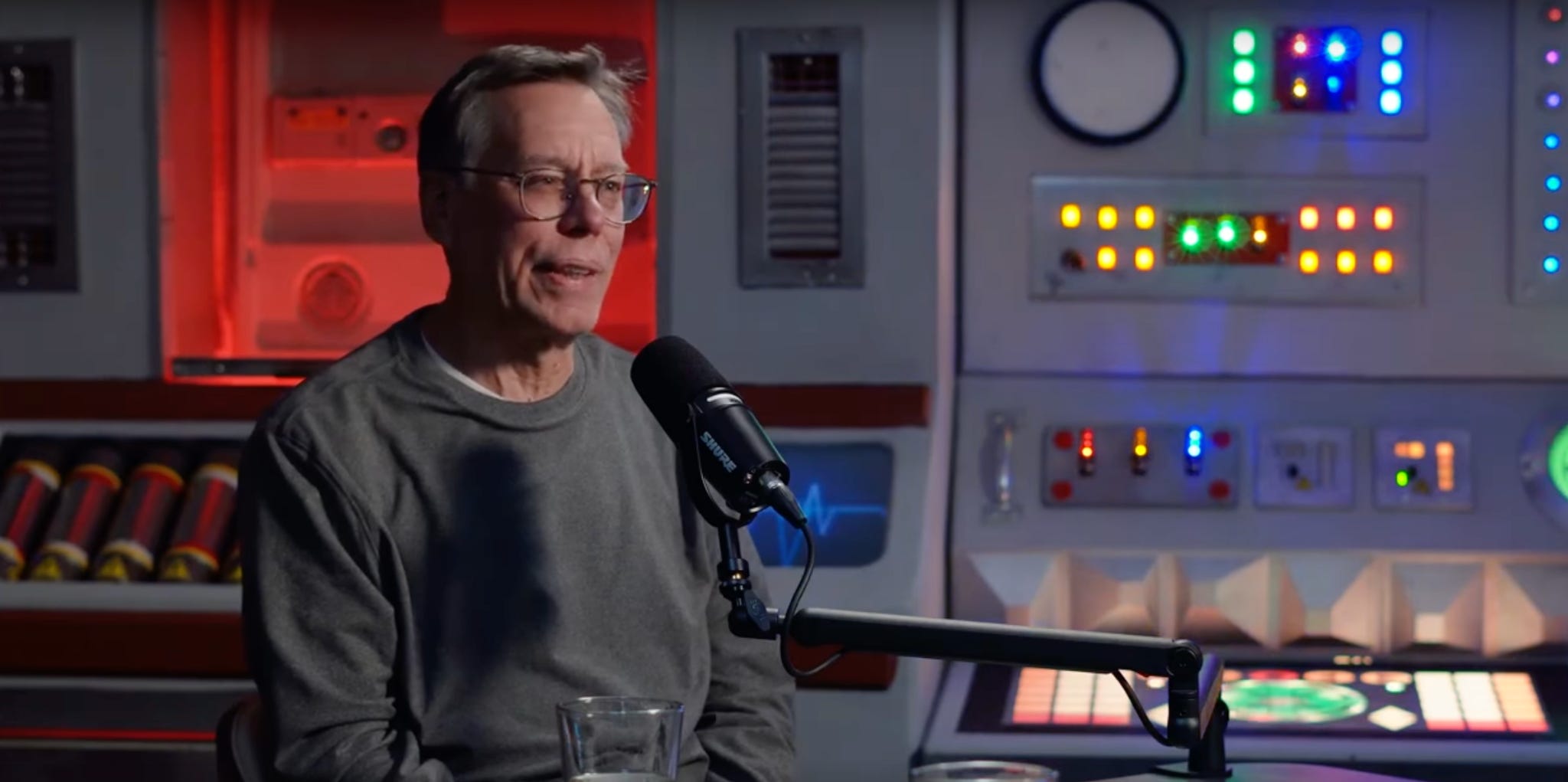
Purported Area 51 whistleblower Bob Lazar sits for an interview on the set of American Alchemy (screenshot)
But in this ecosystem, the line between whistleblowing, tall tale and fantasy can be difficult to discern. On Weaponized, the conversation sometimes veers into spookier fare, like aliens “extracting our souls” and Sasquatch. In addition to Kirk McConnell and Grusch, American Alchemy has hosted an explorer who discussed the alleged capture of a 12-foot-tall giant in Afghanistan and a man who claims his job was to communicate with aliens for the NSA.
Even when sober-minded senior officials do appear in this new media, it is not guaranteed to provide greater clarity about the reality of the UFO situation.
The most notable get in “Age of Disclosure” is an interview with former director of national intelligence James Clapper. Having also led Air Force intelligence, the DIA and the NSA during his 50 years in service, Clapper, now in his 80s, is among the most seasoned intel officials in American history. He is also exceptionally well-positioned to assess just what the U.S. government knows about UFOs. So his mere appearance in a UFO documentary is noteworthy on its own.
Clapper appears only briefly onscreen, but he seems to drop a bombshell: “When I served in the Air Force there was an active program to track anomalous activities that we couldn’t otherwise explain,” says Clapper, who served in that branch from the mid-’60s until the early ’90s, “many of them connected with ranges out West, notably Area 51.”
The statement seems to reveal the existence of a previously unknown UFO program, as well as raise questions about the security of airspace over sensitive facilities, during the long period when the Air Force had publicly disclaimed interest in UFOs.
Filmmaker Dan Farah has certainly cast the statement as a major revelation. He said in a podcast interview that Clapper paused after making it as the gravity of his words set in, and that other intelligence officials in the room during the interview recognized their import. “Their jaws were on the floor,” Farah said, “because it’s such a big statement from a guy like that.”
Clapper’s statement also caused a stir among UFO activists, some of whom have lobbied Congress to demand more transparency from the Air Force about the program he refers to.
The Pentagon referred my questions about the statement to Clapper.
In an email, Clapper’s lawyer, Robert Litt, told me, “Director Clapper was not referring to Project Blue Book or any other specific program focused on UAPs. Rather, he was referring to the fact that in the 1980s, when new aircraft such as the F-117 stealth fighter were being tested in the West, there were a lot of reports of sightings of UAPs that the Air Force tracked down.”
Asked to square this explanation with Farah’s commentary, Litt declined to comment further.
For his part, Farah declined a request to share additional video or transcripts from the interview that might shed light on the context for the original comments.
To add to the confusion, Grusch, appearing on Megyn Kelly’s podcast in January, said that Clapper in fact managed the retrieval of alien craft during his time in government. Litt declined to comment.
****
The rise of the Disclosure movement has come at a time of declining public trust in institutions, and amid a continued fracturing of the media landscape, both driven by the rise of the internet.
These trends have helped Disclosure, as a cultural force, become a vehicle for a general suspicion of government, especially its darker corners, and for a broader questioning of what is real.
This open-minded mood is exemplified by the curiosity about psychic powers that is gaining currency in the culture. At the beginning of last year, the Telepathy Tapes, a documentary-style look at the alleged telepathic abilities of nonverbal autistic children, was the most popular podcast on both Spotify and Apple Podcasts.
In fact, claims about psychics and UFOs are more closely connected than you might think.
In addition to the Disclosure Project, Greer has popularized a movement he calls CE5 — short for Close Encounters of the 5th Kind — in which believers attempt to summon alien entities by channeling psychic powers. Thousands of practitioners now congregate on the internet to discuss their experiences in online groups.
And in the new UFO media ecosystem, accounts circulate from people who say they were subjected to, or are aware of, MK-Ultra-esque efforts by the deep state to recruit children with psychic abilities, often for purposes of communication with aliens.22
These claims have further stoked demands that the government come clean about UFOs.
In May, the Disclosure movement achieved a historic milestone when the Trump administration began a rolling release of UFO-related files on the Defense Department’s website.
But so far, the releases have consisted of previously known documents and ambiguous photos and videos. Rather than offer definitive answers, the releases have mostly provided more fodder for endless online debate about what purported UAP videos actually show.23
The controversy is also kept alive by the often cryptic and confusing statements of senior officials, who alternately give off the impression of harboring a great secret and of not being quite sure what they themselves believe.
Trump alone has expressed skepticism about UFOs, praised military pilots who say they’ve encountered them, suggested he possesses secret knowledge about Roswell, and generally reveled in the ambiguity of his administration’s UFO file dumps.
But even officials who have long embraced the cause of Disclosure can be difficult to read. At the outset of my research last fall, I contacted John Podesta, who, as Bill Clinton’s White House chief of staff, undertook an investigation of government UFO records and rumors of alien bodies at Area 51.
Since then, Podesta, who went on to serve as an Obama White House adviser and as the chairman of Hillary Clinton’s 2016 presidential campaign, has become an outspoken advocate of Disclosure. He has repeatedly stated that the American people “can handle the truth.”
What that truth is, he’s not prepared to say.
In an email, I asked him about UFO-world rumors that, during Obama’s presidency, he had worked with the National Security Council to develop plans to disclose the existence of alien reverse-engineering efforts during Hillary Clinton’s expected presidency.
Podesta responded, “To whet your appetite if you haven’t seen” along with a link to a 2016 Guardian article about the obstacles to Hillary Clinton’s campaign trail vow to look into UFOs.
He did not respond to several follow-up attempts to arrange an interview.
THE NEW SCIENCE OF UFOS
“Either we are dealing with a serious breach of national security or with the biggest scientific discovery in history.” — Harvard astronomer Avi Loeb, June 2026
Rather than wait for government disclosure, a growing number of scientists are taking the initiative to try to crack the UFO enigma themselves.
In doing so, they’re building on a body of knowledge built in the 20th century, largely outside of the scientific mainstream. Volunteer groups like MUFON (Mutual UFO Network), NUFORC (National UFO Reporting Center), and CUFOS (Center for UFO Studies) collected and analyzed information about countless sightings. CUFOS alone boasts a database of close to 200,000 of them.
There were also pioneering analyses produced by Vallee,24 the French astronomer, and Allen Hynek.
By the mid-’70s, Hynek was giving presentations in which he floated the far-out hypothesis that UFOs’ source might be extra-dimensional rather than extraterrestrial. He also noted patterns in the sightings, including silent hovering; rapid acceleration; psychic effects and electromagnetic effects.
Indeed, a review of one dataset compiled by Vallee of 923 UFO sightings from 1868-1968 confirms the recurrence of electromagnetic effects. Sixty-eight of the reports, more than 7 percent, include claims of lights or car engines failing; TV or radio interference; or compasses or watches malfunctioning in conjunction with aerial sightings.
In the early 1980s, European UFOlogists working with MUFON compiled a data set of over 1,300 UFO sightings that were accompanied by apparent electromagnetic effects.
Around this time, UFOlogists like James McCampbell, an aerospace and nuclear engineer by trade, inferred from such patterns that UFOs may produce microwave radiation as a byproduct of their advanced propulsion systems, which might also manipulate gravity.
Until the dawn of the modern UFO era in 2017, such work was conducted mostly on the margins.
Since then, UFOlogy, often under the more technical “UAP” heading, has not only become an acceptable subject of scientific study, it is now emerging as a hot topic among an avant-garde of researchers.
In 2021, the Galileo Project, led by astronomer Avi Loeb, launched at Harvard. It has since published several papers on methods for monitoring aerial anomalies in the Journal of Astronomical Instrumentation.
An even more ambitious effort came last year, with the publication of a 200-page paper on “the New Science of Unidentified Aerospace-Undersea Phenomena” in Progress in Aerospace Sciences. In it, researchers from two dozen institutions — including Wellesley, the State University of New York and UChicago — published a lengthy overview of the subject that reviewed government investigations, links with nuclear weapons, and putative physical evidence for such phenomena.
The paper outlines a transition underway from the collection of eyewitness reports by civil society groups like MUFON and NUFORC to the collection and analysis of data using advanced instruments inside scientific institutions.
Among the paper’s authors is Nolan, the Stanford professor who sits on the Sol Foundation’s board and acts as an important bridge between UFOlogy and institutional credibility.
Nolan has said that his professional interests took a turn in 2013, when he was approached by figures from the aerospace industry about an unusual set of medical cases. As a result, Nolan began examining MRIs of government and aerospace industry personnel who exhibited a cluster of mysterious symptoms, including buzzing noises in their heads. Nolan has said that many of the cohort turned out to have Havana Syndrome, the ailment plaguing U.S. diplomatic personnel that some believe to be caused by Russian microwave weapons. But he has also said that a handful of cases that do not match Havana Syndrome came from patients who reported seeing UAPs and who have scar tissue damage in their brains. He has said the damage might be caused by exposure to a strong electromagnetic field.25
Nolan has also studied metallic debris associated with purported UFO sightings. He has said two of 12 samples he’s analyzed have unusual isotope ratios, and speculated that the material could play a role in the propulsion of UFOs, which might then eject it as exhaust.
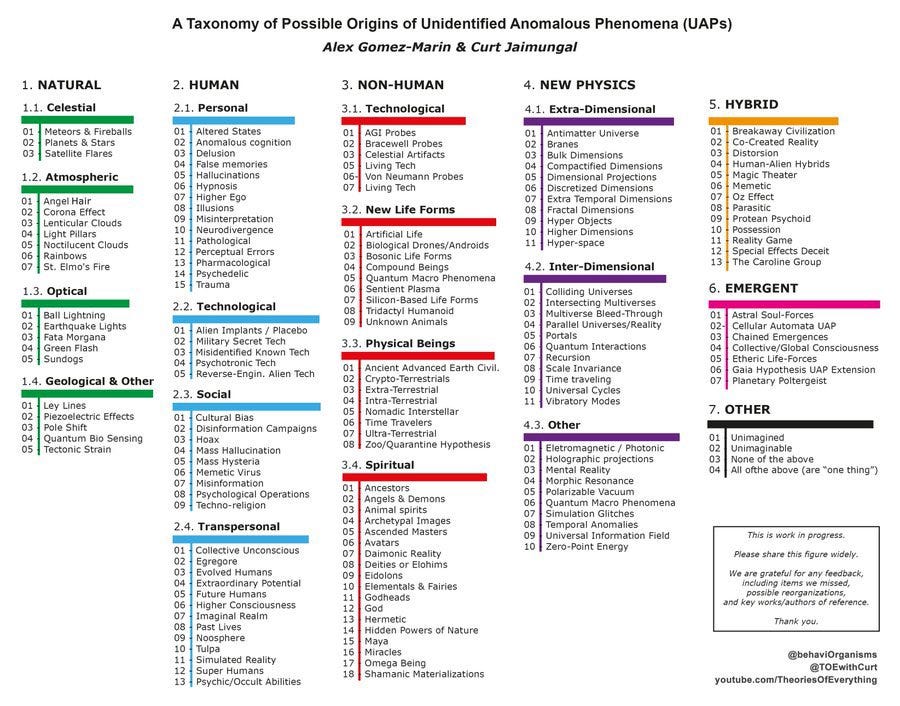
A chart listing dozens of potential UAP explanations, ranging from the mundane to the fantastical. (Via X)
The most arresting findings to pass peer review thus far are probably from a pair of studies led by Beatriz Villarroel, an astronomer at the Nordic Institute for Theoretical Physics in Stockholm. The papers found statistical patterns that Villarroel believes could offer the first evidence for a key pillar of the Lore: the relationship between UFOs and nuclear weapons.
To find support for the relationship, Villarroel and her collaborators examined “fast transients,” specks of light that pop up in some time series photos taken from observatories of the night sky — but do not appear in photos taken seconds later.
One prosaic explanation for these transient specks of light is that they are random noise caused by minor instrument issues, such as bits of dust on an observatory’s photographic plates.
Villarroel suggests a dramatically different explanation for the specks: that they are glints of sunlight reflecting off of fast-moving alien spacecraft that showed up to monitor humanity’s early experiments with nuclear weaponry.
In a paper published last fall in Scientific Reports, a journal in the prestigious Nature portfolio, Villarroel et al. found that transients in a set of photographs from a San Diego observatory appeared 45 percent more frequently in the 24 hours before and after the dates of nuclear tests. (To preclude the possibility that the specks of light were caused by man-made satellites, the authors restricted their study to photos taken before the 1957 launch of Sputnik, the first man-made object to orbit the Earth.)
The mere appearance of the paper in a Nature journal was a signal event for the mainstreaming of UAP studies.
A second paper, published in an astronomy journal, found that these transients were more likely to appear in places where an object in space would reflect light from the sun, suggesting, the authors argue, that the transients could be caused by fast-moving physical objects.
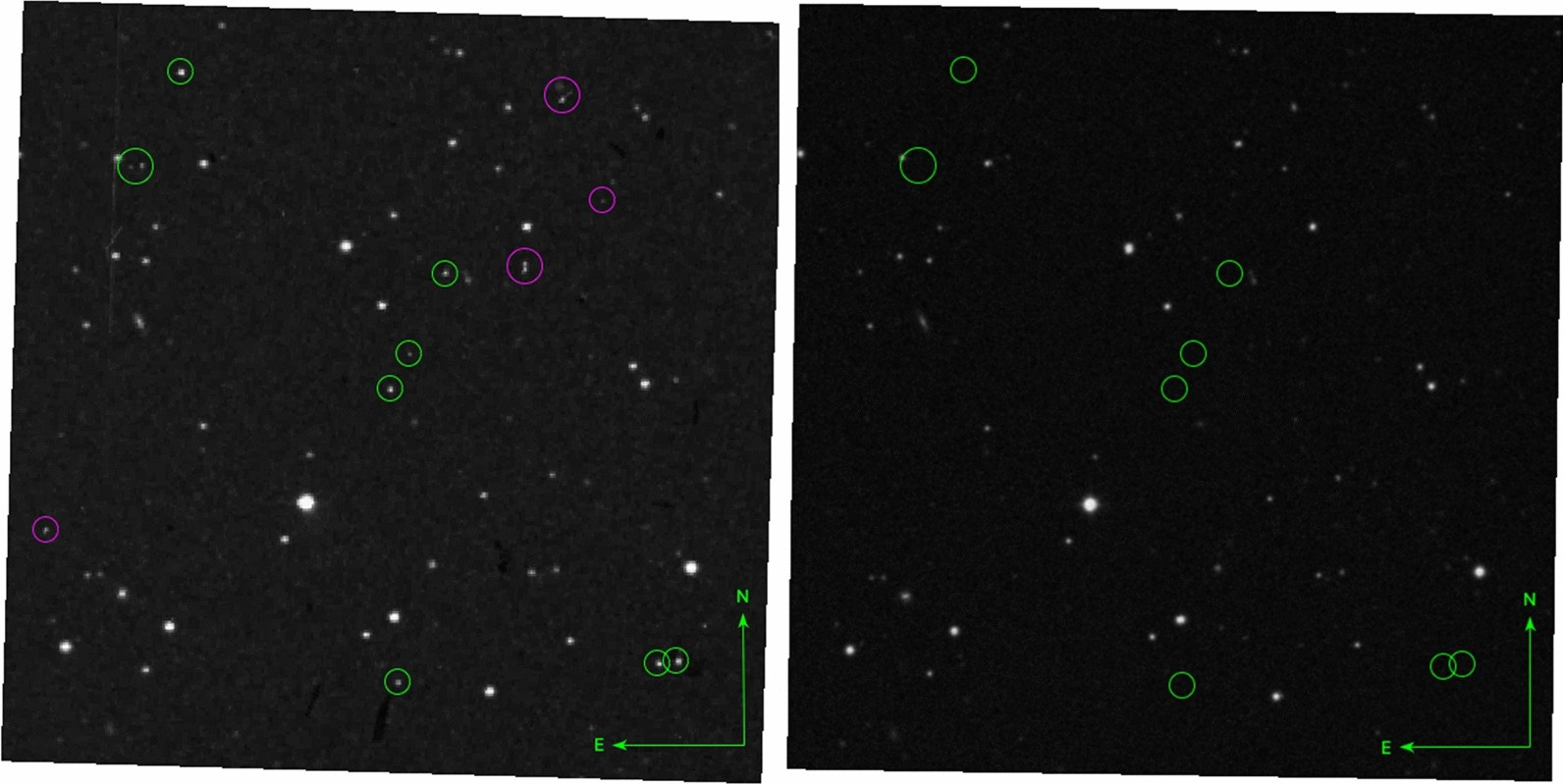
Images such as these, taken from the Palomar Observatory in California, are at the center of an unlikely scientific debate: Are the disappearing white specks bits of dust or UFOs? (Scientific Reports 11, 12794 (2021))
Of course, the papers have provoked deep skepticism, even among researchers who take UAPs seriously, that their statistical inferences really point to the presence of non-human craft. In the months since their publication, a lively debate has begun playing out, largely on arXiv (pronounced “archive”), an online repository for preprints of scientific papers that have not yet been published in peer-reviewed journals.
One preprint that appeared in January — authored by researchers from Wellesley, SUNY and elsewhere — finds fault with the papers’ methods on several grounds, and argues that their findings amount to statistical illusions.26
Another preprint, posted in March by an independent researcher from Texas, attested to the validity of the original papers’ statistical analyses. A third preprint, also in March, by a retired software engineer for NASA, examined fast transients in photographic plates taken at the Hamburg Observatory in the mid-1950s. It found that an analysis of their shape “provides further support for their interpretation as sub-second optical flashes, consistent with reflections from flat, rotating objects in orbit around Earth.”
The debate remains far from settled, and there are signs that this new era of institutionally sanctioned scientific studies of UAPs is only just beginning.
After a wave of UAP sightings rocked New Jersey last year (now partially attributed to drone activity), the state has appropriated funding for a UAP research center.
And in November, SUNY Albany announced that a donor had made a “major gift” of unspecified size to support ongoing UAP research led by physicist Kevin Knuth, lead author of a 2019 paper in the journal Entropy analyzing UFOs’ apparent flight patterns.
THE UFO GOLD RUSH
“Looking for the black world was like looking for evidence of black holes” — Nick Cook, The Hunt for Zero Point
Despite the lack of scientific consensus that UFOs are alien technology, or represent any kind of exotic phenomenon at all, entrepreneurs and investors are already jockeying to profit from potential breakthroughs.
This speculative gold rush was on display last October at the luxe Grand Hotel Dino on the banks of Lake Maggiore in northern Italy. There, interested parties ponied up $500 a head to attend the annual conference of the Sol Foundation, the UAP-focused think tank led by Nolan and anthropologist Peter Skafish.
The swanky atmosphere led one attendee, Dario Garcia Giner, to voice a surprising critique: UFOlogy had gone corporate. “I was expecting a polished affair,” he wrote in the Blind Spot, a publication for sophisticated investors. “But I never imagined it would be this refined.”
Noting the contingent of besuited venture capitalists, private equity investors, and military contractors on hand, Giner concluded that “UFOs have entered their Davos era.”
The proceedings included a presentation by Skywatcher, a venture launched last year on the premise that it could summon UAPs on command using two methods.
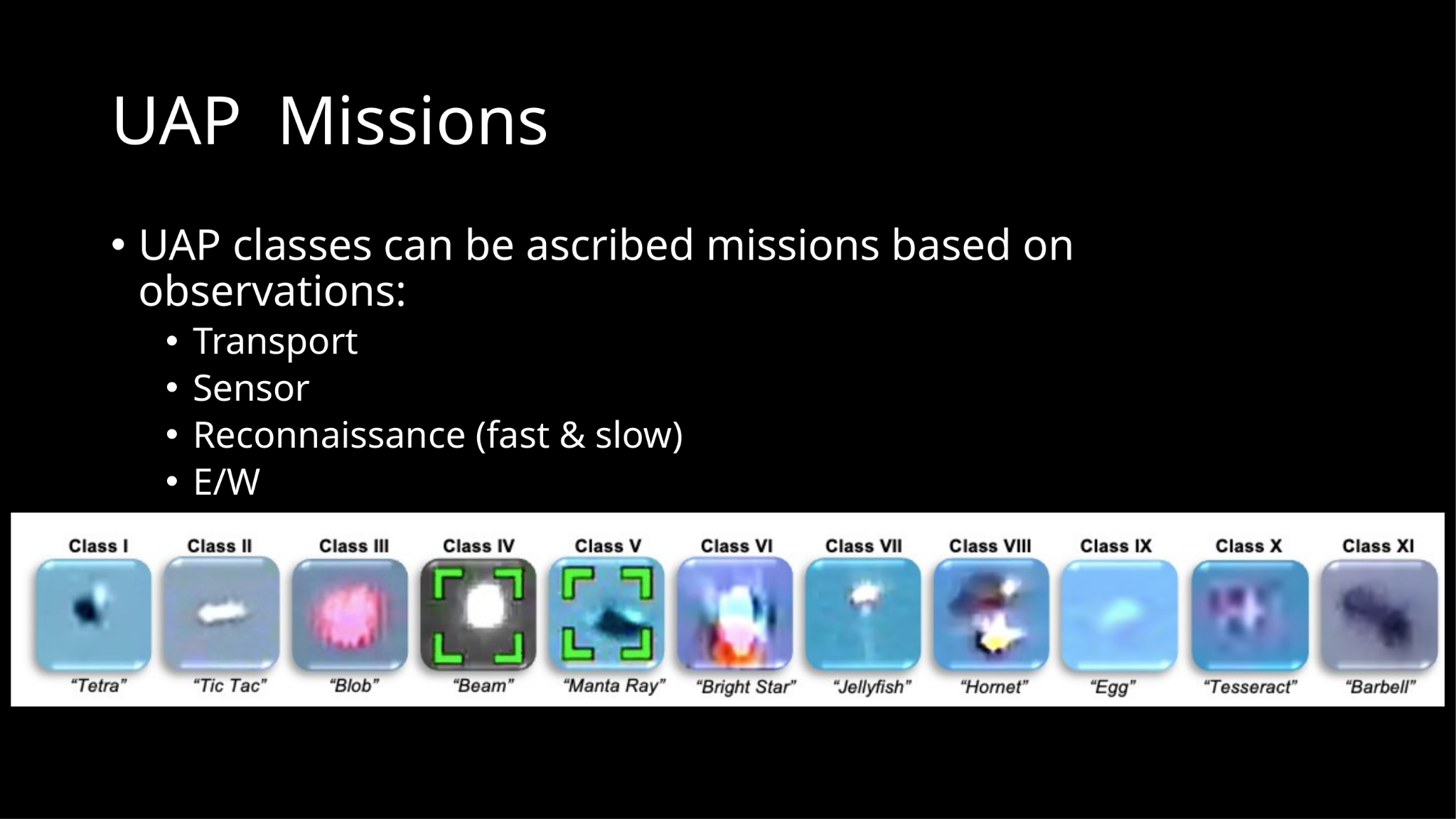
Slide from a Skywatcher presentation laying out 11 classes of UAPs that can allegedly be attracted with a high-tech “dog whistle.” (Courtesy of James Fowler)
The first claimed method is a high-tech “electro-mechanical dog whistle.” The second method is called “psionics” or “Neuromeditative Interaction.” Basically, psychic powers.
Despite launching last year with great fanfare – including coverage by cable’s NewsNation — Skywatcher has not released proof that it is in fact summoning UFOs.
In an interview late last year, Skywatcher co-founder James Fowler told me that he stumbled upon the dog whistle technique in 2021 while providing support for war games as a military contractor. He said he detects the UFOs using radios, radar and other sensor systems. Fowler, who is no longer working with Skywatcher, told me he initially believed the objects he was detecting were a secret American system, but that he has since ruled that out, and that he keeps the U.S. military apprised of his activities.
He said other members of Skywatcher are responsible for the psychic summoning, and that he could not vouch for its efficacy. He also said he has collected terabytes of UFO data, but declined to share it, saying it would give away his proprietary summoning method.
Fowler is just one of the entrepreneurs promoting the promise of unproven UFO technologies.
To The Stars, a company founded by Blink-182 frontman Tom DeLonge, along with Puthoff and others, launched in 2017 with plans to exploit alleged UFO technologies like electromagnetic propulsion. In 2019, it entered into an agreement with the Army to cooperate on the research and development of technologies including “beamed energy propulsion” and “active camouflage,” according to a filing it made with the SEC. Under the agreement, the company provided fragments of possible UFO material to the Army for analysis.
But in a 2024 report, the Oak Ridge National Laboratory concluded the material was “terrestrial in origin.” The company’s speculative technologies do not appear to be nearing commercial viability: In recent SEC filings, the company describes its primary business focus as its media production subsidiary.
The lack of results from Skywatcher and To The Stars has not deterred other entrepreneurs from getting in on the game.
In February, venture capital firm American DeepTech, led by Anna Brady Estevez, an alumna of Boston Consulting Group, announced that it was launching an initiative to capitalize on the Trump administration’s disclosure initiative by commercializing technologies derived from and inspired by UFOs.
That same month, a disclosure-themed ETF created by Tuttle Capital Management started trading. It currently boasts just $3 million under management, spread among the stocks of companies like Palantir and Lockheed Martin that could hypothetically benefit from the disclosure of alien technology.
****
At the nexus of rumored alien technologies and real-world business applications sits the world of private military contractors. This is where Harry Reid, David Grusch and others have suspected that many secrets of “the Program” are hidden, and where Disclosure advocates are directing much of their scrutiny.
Even if alien technology is nowhere to be found, investors have other reasons to pay attention to a movement determined to shine a light into the darkest corners of these contractors’ Black World projects. In his Sol conference dispatch, Giner points out that the Disclosure movement gives tech entrepreneurs and foreign powers an avenue to pump the U.S. government for insight into its secret military programs, and speculates that the UFO furor may offer a “Trojan Horse” for those seeking to shake up the military-industrial complex.
UAP transparency efforts could, for example, yield valuable intelligence about advanced drones or next-generation decoys.
In fact, a small subset of Black World watchers have long speculated that the military has secretly achieved revolutionary breakthroughs in physics. Such breakthroughs, they argue in turn, could lead to applications like gravity manipulation or the harnessing of “zero-point energy” associated with the “quantum vacuum.” Some UFOlogists argue that these technologies could explain the extraordinary flight patterns ascribed to UFOs.
This speculation is fleshed out most thoroughly in “The Hunt for Zero Point,” a 2001 book by the British journalist Nick Cook.
Cook, while serving as the aerospace editor for the staid trade publication Jane’s Defence Weekly, received an unexpected tip about decades-old American military research. The tip led him to probe American post-war efforts to appropriate secret Nazi science projects, a subsequent American push into gravity research, and occasional claims since then that scientists have figured out how to harness anti-gravity.
As Cook investigated the case that the U.S. has secretly achieved mind-bending aerospace breakthroughs, he examined the possibility that the flying discs seen in the skies after World War II were actually experimental man-made craft.
But Cook found no simple answers. Instead, his journey down a Black World rabbit hole, through the Lore and to the frontiers of secret military tech has shaken the foundations of his worldview.
Decades later, he, too, is now calling for radical reorientation.
In April, he and Pippa Malmgren — a former White House economic adviser under George W. Bush and the daughter of Harald Malmgren — founded the Exo Institute. It describes itself as a forum that “integrates consciousness and anomalous phenomena in developing a more complete understanding of the true nature of reality.”
REALITY SHOCK
“There are more things in heaven and earth, Horatio, / Than are dreamt of in your philosophy” — Hamlet
In philosophy, ontology is the study of what is real. The term “ontological shock” refers to a state of profound disorientation a person experiences when they are forced to revise their basic assumptions about reality. In UFO circles, it has gained currency as a way of describing the process people go through when confronted with evidence for the existence of alien intelligence.
One Senate aide exposed in recent years to classified briefings about UFOs and alleged reverse-engineering efforts was sent into a state of ontological shock that lasted several weeks, according to a person briefed on the episode. The aide declined an interview request, but some lawmakers have made clear the unsettling effects of the information they are receiving behind closed doors.
“If they were to release the things that I’ve seen, you’d be up at night, worrying,” said Tennessee Republican Rep. Tim Burchett, who sits on the Oversight subcommittee investigating UFOs, in an April television appearance. “This country would have come unglued,” he said, “if they would have heard all that I heard.”
Clearly, something destabilizing is bubbling up from the Black World, and the UFO mystery cannot be solved without a better sense of exactly what.
One perspective could start with the initial 1947 misunderstanding about the “saucer” shape, then move to the apparent role of confusion and military disinformation in seeding the Roswell myth, then on to the long list of intentional hoaxes and mistaken eyewitnesses. It would focus on the unusual beliefs held by many of the national-security insiders who brought about the current UFO era and the lack, after decades of controversy, of decisive photographic evidence.
With these aspects of UFO history in the foreground, it looks like a tale of human error and the suggestibility of the collective consciousness.
It would make the present commotion, with government and scientific resources being spent to investigate the more extraordinary claims of the Lore, one of the great delusions of all time — something comparable to the quests for El Dorado or the Fountain of Youth.
From this perspective, it would appear that the only thing emerging from the Black World is the rotten fruit of its own secrecy and deception, poisoning the minds of many of its denizens, overseers, and now members of the public, to the point that they have lost their grip on reality.
Another perspective might emphasize accounts supported by multiple trained witnesses and infrared video, as well as the persistence of government interest. There’s the growing number of statements of concern from officialdom. And the fact that, over the decades, the trend has been from vague and suggestive comments, to, in recent years, increasingly explicit claims about a link between UFOs and non-human intelligence (as well as reverse-engineering).
There’s also the recurring association of UFOs with apparent electromagnetic effects, and other patterns in sightings that arguably constitute the signature of a real, anomalous phenomenon. (Some UFOlogists cite instantaneous acceleration, lack of apparent means of propulsion, and supersonic flight without a sonic boom among these signature characteristics).
From this perspective, it would appear that long-suppressed truths about UFOs, and perhaps aliens, are finally emerging from the Black World.
****
Whichever way you look at it, Deep State leaks and congressional hearings make for odd prisms through which to view mysteries about the nature of reality.
UFO anomalies do not fit easily into existing bureaucratic categories, and attempts to account for them regularly threaten to expose state secrets. It is no wonder that governments have repeatedly abandoned their inquiries without arriving at definitive conclusions.
But Pandora’s Box is now firmly open. And by focusing attention on things that governmental institutions are unable or unwilling to satisfactorily account for, these mysteries are testing the limits of those institutions.
Scientific and media institutions have been similarly hard-pressed. As a result, supernatural theories have seeped into the explanatory void: One school of thought endorsed by Vice President J.D. Vance, a convert to Catholicism, holds that UFOs are demons.
It’s a prospect that is difficult to entertain within an institutional context that has long been defined by Enlightenment rationalism, scientific materialism and the separation of church and state.
But the present UFO flap is demonstrating its potential to destabilize that context.
In part, that’s because the mere investigation of the UFO mystery can induce a sort of ontological shock simply by forcing a person to reckon with the limits of their own perception and understanding.
Humans can directly detect only a narrow band of the electromagnetic spectrum as visible light. We have access to a few dimensions of space and time, even as scientists theorize the existence of many more. We naturally perceive a certain scale within those dimensions, even as we have become progressively aware of phenomena that exist on much larger and smaller scales. Math and literacy are recent inventions in the context of human existence. Abstract theories of physics are newer still, and have been subject to regular upheaval.
Facing these facts, it is hard to feel confident that our understanding of reality is remotely complete or especially stable.
If advanced, multidimensional beings were interacting with humanity, it is reasonable to suppose this could generate a body of reports as bewildering as the ones associated with UFOs. It is also reasonable to suppose that we might eventually figure out what’s going on, and adjust our understanding of the world accordingly.
As optics advanced in the early modern period, the realization that the Earth orbited the sun and the discovery of microscopic organisms were both met with initial disbelief, before being universally accepted.
The present flap comes at a time when new tools for collecting and making sense of information about the world are rapidly improving. Momentous discoveries could plausibly follow.
But, as Thomas Kuhn demonstrated, scientific consensus is not merely a question of technical advance. Its evolution has social and political dimensions. Meteors offer one (potentially apt) illustration. For centuries, reports of rocks falling from the sky were dismissed as the ravings of ignorant peasants. That changed when a meteor shower sufficiently close to Paris swayed elite opinion.
UFO anomalies, likewise, are not the province of science alone. The subject has long taken on political and even spiritual dimensions.
The current UFO era, coming at a time when populist movements and online media have undermined old authorities, is no exception.
Perhaps it should not come as such a shock, then, that the reemergence of the UFO mystery has become the occasion for a broader reevaluation of reality.
It’s a process that promises to have plenty of terrestrial consequences. Whether or not the discovery of alien intelligence is one of them remains a matter for further investigation.
IF YOU FOUND THIS GUIDE USEFUL, PLEASE FORWARD IT FAR AND WIDE. STAY TUNED FOR MORE.
APPENDIX A: Possible Precedents
The annals of human history fail to offer anything quite like today’s sprawling, bewildering UFO phenomenon. But several historical episodes offer useful touchstones for anyone striving to make sense of it.
Meteors: For centuries, the learned elites of European capitals consistently rejected reports of rocks falling from the sky as folklore fed by the delusions of ignorant, superstitious peasants.
In 1803, the French Academy of Sciences sent scientist Jean-Baptiste Biot to investigate reports of a meteor shower in Normandy. His detailed findings finally swayed learned opinion.
The Salem Witch Trials: A mass hysteria exacerbated by social incentives and official government sanction. Just as belief in UFO lore has lasted for decades despite a lack of proof, belief in witchcraft has recurred in human societies for eons despite the lack of evidence for supernatural powers.
The Heliocentric Solar System: History’s most famous example of a scientific discovery that was repressed because it undermined the authority of an existing power. Galileo showed that the Earth moved around the sun, but the Church forced him to recant.
Microbes: Early modern improvements in optics did not just allow humans to peer deeper into the sky. In the 1670s, Antonie van Leeuwenhoek, a shopkeeper and minor Dutch official, built a more powerful microscope.
He found a whole hidden world, teeming with life, at a microscopic scale. But his letters detailing his discoveries were met with skepticism for years by the scientific establishment, until the findings were independently replicated.
It was not until the 19th century that one implication of the discovery, germ theory, became widely accepted and revolutionized public health.
The Resurrection: The resurrection was initially an article of faith among a small group of believers who relied on the testimony of a tiny group of witnesses. Eventually, it was accepted as a core tenet of the world’s largest religion.
Historians tend to accept the historical truth of some basic facts surrounding the event, such as the crucifixion of Jesus, though secular scholarship generally does not accept the notion of a literal resurrection.
From a historiographical perspective, the Roswell event, especially, shares many defining characteristics with the resurrection, suggesting its potential to form the basis for a future religious belief system.
APPENDIX B: Further reading
UFOs:
“UFO: The Inside Story of the US Government’s Search for Alien Life Here―and Out There” by Garrett Graff (2023). A straightforward history of the UFO phenomenon through about 2020 that balances open-mindedness with scholarly skepticism. Graff, a chronicler of the U.S. national security state, interweaves this account with the lesser-known history of mainstream scientific efforts to find life in the distant cosmos.
“The Hunt for Zero Point,” by Nick Cook (2001). A British editor at Jane’s Defence Weekly, a trade publication for the military-industrial complex, gets a tip that sends him on an odyssey through the “Black World” of secret military tech and the dark history of Nazi science. Cook suspects, but never quite proves, that the U.S. has secretly pursued gravity manipulation technology similar to the gravity propulsion systems that have been speculatively attributed to UFOs.
“UFOs and Nukes,” by Robert Hastings (Second Edition: 2017). Hastings, an Air Force brat, glimpsed the prelude to a notorious UFO incident as a teenager at a base in Montana in 1967. He went on to spend much of his adult life cataloging eyewitness accounts of similar episodes at other nuclear facilities. The book has become something of a bible in contemporary UFOlogy, which conjectures a close link between UFOs and nuclear activity.
“Passport to Magonia: From Folklore to Flying Saucers” by Jacques Vallee (1969). A classic early work by the French eminence grise of UFOlogy. The book finds continuities between modern accounts of close encounters and millennia’s worth of folktales and religious stories about mystical encounters with otherworldly beings.
“Triangle UFOs: An Estimate of the Situation” by David Marler (2013). Marler, executive director of New Mexico’s National UFO Historical Records Center, models his study of triangular UFO reports on a military threat assessment. His conclusion: “We appear to be confronted with something other than human technology, therefore the implications are profound.”
History of science:
“The Structure of Scientific Revolutions” by Thomas Kuhn (1962). A classic of science history and the theory of knowledge, the book introduced the term “paradigm shift” into the modern lexicon. It documents a recurring pattern in scientific upheavals that offers a framework for understanding current controversies over empirical anomalies.
“Einstein’s Clocks, Poincare’s Maps: Empires of Time” by Peter Galison (2003). Galison, a historian of science, documents the context that gave rise to the great paradigm shift of the 20th century: relativity. The book convincingly demonstrates the extent to which technological change, driven by political and economic imperatives, created the conditions for a breakthrough that is often treated as pure theory.
Could a secret military arms race be on the cusp of forcing a 21st-century revolution in physics, just as imperial expansion and the telegraph did at the turn of the 20th?
Terminology can get tricky when trying to precisely describe bewildering phenomena whose existence remains controversial. This piece will lean on the terms “alien” and “UFO” because their general gist is widely understood.
It should be noted, though, that the term alien has been supplanted in recent years by the more scientific-sounding “Non-Human Intelligence” or NHI. Either term is preferable in most contexts to “extraterrestrial,” which assumes that the (alleged) intelligent beings in question originate from somewhere outside the Earth, usually another planet.
The term UFO, likewise, has been supplanted by the more general “Unidentified Aerial Phenomenon,” which does not assume a sighting was a physical object. Some prefer the even more general term “Unidentified Anomalous Phenomenon,” which also covers, for example, underwater sightings, but is sometimes stretched to cover almost any unusual thing under the sun. Both of those terms are often shortened to UAP.
“Are aliens real?” Obama was asked by a podcaster in February. Obama replied: “They’re real. But I haven’t seen them. And, they’re not being kept in Area 51.”
After the comments made headlines, and before Trump accused him of revealing classified information, Obama issued a clarification via Instagram that cast his initial remarks as a probabilistic inference: “Statistically, the universe is so vast that the odds are good there’s life out there. But the distances between solar systems are so great that the chances we’ve been visited by aliens is low, and I saw no evidence during my presidency that extraterrestrials have made contact with us.”
While the flying saucer shape has become culturally dominant, it is worth noting that actual sightings are distributed across a range of shapes, including triangles, orbs, and cylinders. Here’s one Pentagon breakdown and a civilian count.
Under pressure to deliver answers in an atmosphere of near-hysteria, Hynek suggested that spontaneously igniting swamp gas explained some of the strange aerial sightings that swept Dexter in March 1966. He later blamed the press for creating the impression that gas explained the entire episode, which, he maintained, remained largely unsolved.
One such project was the U-2 spy plane, whose unprecedented cruising altitude made it the cause of many UFO reports before its existence was exposed.
One conservative estimate from a 2008 psychology paper pegs the number of reported abduction experiences at “at least several thousand.”
"The other thing that he said was don’t worry about science, because in this culture science has become a new kind of theology. What you’re really interested in, he said, is trying to learn something and gain knowledge, whether it’ll satisfy science or not. Science prefers to study primarily within the purely material world, he said, but don’t worry about that." (Via John Mack Institute)
The report said the hieroglyphic markings recalled by Marcel were actual floral designs on tape used to rig the balloons together. In a subsequent report, published in 1997, the Air Force offered ordinary explanations for many of the claims witnesses made decades later. It traced claims about alien bodies to confused memories of military test dummies that had fallen in the desert.
Subsequent investigations offered partial corroboration of Lazar’s claim that he had worked at Los Alamos National Laboratory, while debunking his claims to have earned degrees from MIT and Caltech.
Like “The Day After Roswell,” a 1997 book by the late Philip Corso, then a retired Army intelligence officer.
Notably the notorious “Majestic 12” documents, which purport to show that Harry Truman convened a top-secret committee of a dozen luminaries, including Twining, Bush and Defense Secretary James Forrestal to reverse-engineer the craft.
In 2021, the late former Senate majority leader Harry Reid told The New Yorker, “I was told for decades that Lockheed [Martin] had some of these retrieved materials.” The company has generally declined to comment publicly on the subject.
View the version in Australia’s national archives here.
Project Condign, a since-declassified UK military study, conducted around the same time, found most UFO sightings had banal explanations but that some may be caused by rare atmospheric plasmas.
The eminent domain provision proposed in the Senate has not made it into law, but a person familiar with the legislative wrangling told me it remains ongoing. In July, the House passed a UAP Disclosure amendment to its version of the 2027 NDAA.
The audience of a niche defense publication, the Debrief, got a preview of Grusch’s claims in an article published the month before.
See this April 2025 American Alchemy episode, from about the seven-minute mark.
While the report does not name this “group of individuals,” it is clear from context that it largely overlaps with the loose-knit group of former officials and consultants who have publicly endorsed reverse-engineering claims.
Independent journalist Douglas Dean Johnson has made an extensive case that the test produced no such UFO downing and has generally cast Malmgren’s accounts of his professional exploits as unreliable. In response to Johnson and other skeptics, Malmgren’s daughter, Pippa Malmgren, shared photos of her father with Richard Nixon and other top officials, and told me that diary entries and other documentation in her possession corroborate her father’s accounts of his work.
For his part, Grusch, at a June press conference, alleged the government is aware of several types of intelligent aliens: "It's a continuum from corporeal bipedal type life to, you know, what I would consider is like sentient plasma life."
Elizondo focuses on what he calls “the five observables”: instantaneous acceleration; faster-than-sound travel without sonic booms; low observability; trans-medium travel through air and water; and positive lift without visible means of propulsion.
No tangible evidence has emerged to support the claim, although the U.S. government’s interest in purported psychic powers during the 20th century is well documented, notably in the 2017 book Phenomena by Annie Jacobsen.
Notably the years-long, ongoing, extremely in-the-weeds debate between skeptic Mick West, who argues that military UFO videos are the result of optical illusions and technical quirks, and Marik von Rennenkampff, a veteran of the State and Defense departments who argues that they show real objects moving in extraordinary ways.
In 1975, Vallee and a French collaborator, Claude Poher, presented “Basic Patterns in UFO Observations” to the American Institute of Aeronautics and Astronautics, in which they presented an early statistical analysis of sightings and argued that UFOs were physical objects of a genuinely unknown nature.
See, e.g., Jacobsen’s Phenomena, which documents the role of former CIA doctor Kit Green in investigating the same set of medical cases.
In a rebuttal, Villarroel and others take issue with their critics’ methods and conclusions.
I have found this space so difficult to navigate. You have done a great service by putting all this research together in one place thank you.
Thank you so much for jumping into the scrum, Ben. This is a really great piece, and a solid map of the terrain for people new to the topic (the most solid I've encountered from an actual journalist), that is, with one exception I'd like to respectfully call out.
You list Puthoff's remote viewing work among the "fringe activities and beliefs" that skeptics cite against the reverse-engineering crowd... though please note the government already adjudicated that question, and the answer goes the opposite way.
In 1995, the CIA commissioned the American Institutes for Research to evaluate the Stargate program, right before "shuttering it." The review's statistician, Jessica Utts of UC Davis, concluded that the statistical evidence for the anomalous effect was established. Her words were that it "far exceeds what is expected by chance," and that further experiments aimed at proving mere existence would be a waste of resources.
Also - her skeptic counterpart, Ray Hyman, agreed the effect sizes were statistically significant and conceded he could not identify the methodological flaw producing them; he simply declined to accept the parapsychological interpretation.
So while most people still look at RV as fringe, that's clearly a government-commissioned finding that the phenomenon under study produced replicable, significant results across SRI and SAIC... which is presumably why CIA and DIA funded it for two decades. (Also note: Whether it stayed shuttered is a separate question - Kona Blue's proposed scope suggests the institutional appetite never closed.)
Notice, too, that psi isn't incidental to your subject, rather Id say it's structural. Your Lore section notes the craft were reportedly "steered telepathically." And the 1950 Wilbert Smith memo you cite reports that U.S. authorities were already investigating "mental phenomena" in connection with the saucers, in the same breath as Vannevar Bush and above-H-bomb classification. So, as you can see, the consciousness thread runs through the earliest documented government inquiry, not just the modern personalities.
Therefore, I'd argue that Puthoff's career shouldn't be angled as a believer dragging his eccentricities into the subject; when in fact the security state that hired him is investigating along the same exact axis the reports had pointed to since at least 1947.
Most recently, this also connects to your Skywatcher reporting. The "psionics" method communicates like the absurd half of their pitch, only if the underlying phenomenon was never substantiated...but again. that question was settled in 1995, by the government's own reviewers. The current critique of Skywatcher therefore isn't whether psychic functioning exists; it's whether their application of it produces the summoning results they claim, which is exactly the data Fowler declined to release. Which we should simply ask, why?
And even more interestingly the story has moved since your interview (which might be a place for follow up): the skywatcher group has gone dark, and Ross Coulthart is now reporting - via NewsNation, tied to February's abrupt FAA closure of El Paso airspace - the allegation that a classified government operation absorbed Skywatcher's dog-whistle and psionic techniques for its own detection-and-intercept purposes.
Granted that's a single-source claim and should be weighted as one. But we should all note its shape, and discern: the alleged government response to a psionic summoning outfit wasn't public ridicule, it was...acquisition?
You can certainly argue about what remote viewing is, though treating Puthoff's involvement in it as a credibility deduction actually inverts the record, which is: he ran a program whose core empirical claim survived hostile review by the government that paid for it.
If anything, it's a data point that the national security state takes consciousness-adjacent anomalies more seriously than its public posture admits, which is rather the theme of your piece.