


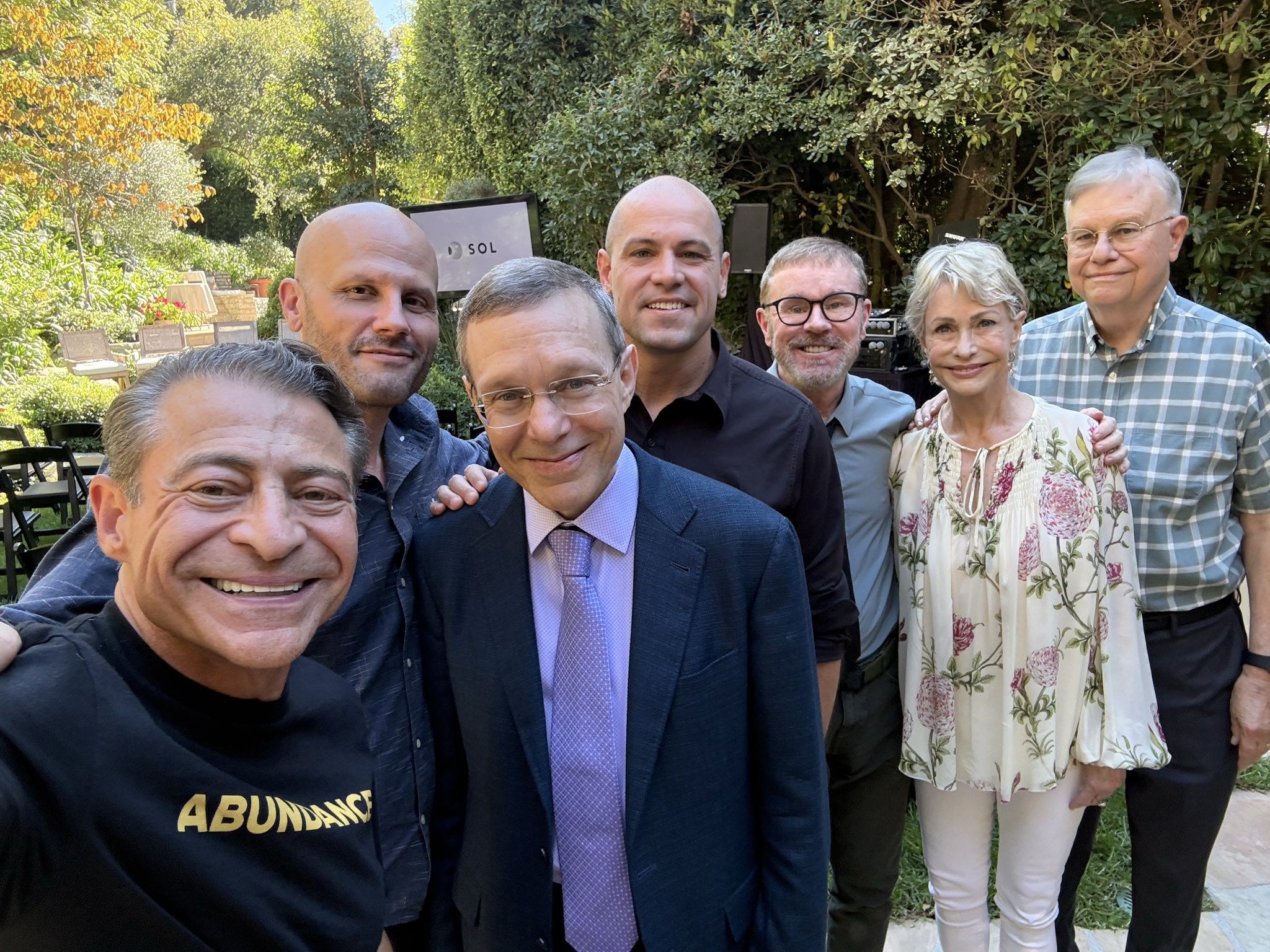
XPRIZE Chairman Peter Diamandis (left) at a weekend event with UFO researchers and activists (source: Diamandis’ X Account)
The chairman of the XPRIZE Foundation is exploring the creation of a new prize for providing proof of alien technology, according to four people involved in the process.
The creation of an “XPRIZE for aliens” would mark a major milestone in the transformation of a once-fringe topic into a prestigious subject of scientific inquiry.
Early discussion of the prize has focused on evidence of alien visitation, as opposed to detecting life in far-off star systems, according to the people.
“The basic point is to identify technologies that are of non-human origin in the form of objects near Earth,” said Harvard astronomer Avi Loeb, who is advising XPRIZE executive chairman and founder Peter Diamandis on the initiative.
Loeb, who also leads the UAP Science Advisory Council that is advising the Trump administration on UFO issues, said that the biggest obstacle to launching the prize is securing funding. Loeb said he had identified a potential funder but declined to name the person “until it’s finalized.”
Since its founding in 1994, the XPRIZE Foundation has become a top scientific agenda-setter by creating prizes for specific breakthroughs. It offers bounties ranging from roughly $5 million to $100 million, depending on the prize.
Loeb said the foundation’s board would need to approve an alien-themed prize. Neither Diamandis nor the foundation responded to requests for comment.
Diamandis, a serial entrepreneur, published an essay in September titled “The Evidence Around UAPs Is Getting Harder to Ignore.” UAP stands for unidentified anomalous phenomena, the official term for UFO.
“I am not asking you to believe,” Diamandis wrote. “I am asking you to look. The evidence is there. The people coming forward are credible. The correlations are statistically significant. The government is preparing.”
This past weekend, Diamandis and filmmaker Lyn Lear co-hosted Los Angeles-area events to discuss the evidence for possible alien visitation and the details of a potential XPRIZE.
About 100 people gathered at Diamandis’ Santa Monica home on Saturday to hear from several luminaries of the Disclosure movement, which advocates for government transparency on UFO matters. Speakers included Loeb, Stanford medical school professor Garry Nolan, former Navy fighter pilot Ryan Graves, founder of Americans for Safe Aerospace, and Peter Skafish, executive director of the Sol Foundation, a Disclosure-focused think tank.
Graves, who testified to Congress about military encounters with UAP in 2023, called the prize-planning “a tremendous indicator of how this conversation has matured and advanced.”
According to Graves, Diamandis said that a potential funder for the prize has been identified but that no firm commitment had been made.
Graves added that Diamandis has come to view the possible presence of nonhuman intelligence as more consequential than the rise of artificial intelligence. “He sees this as a central issue,” Graves said. “Not just something he’s exploring on the fringes.”
PARADIGM has separately learned that Graves has joined the Trump administration’s outside UAP Science Advisory Council as its latest member.
Other attendees at Saturday’s event included actress Jane Fonda, Communion author Whitley Strieber, and Susan McCue, who served as chief of staff to the late Senate majority leader Harry Reid.
Musician George Clinton RSVP’d to attend but did not make it. (Clinton has long maintained that he and bandmate Bootsy Collins encountered a real UFO in Canada after embarking on Parliament-Funkadelic’s mid-’70s P-Funk Earth Tour, which featured the collective’s famous “mothership” UFO prop.)
Lear, the widow of television producer Norman Lear, said the event came about after she ran into Diamandis earlier this year and the pair discussed their mutual interest in aliens.
She said their discussions then turned to a potential alien XPRIZE. She said that Diamandis and his foundation are currently “looking into it.”
“I think everybody on the cutting edge,” she said, “knows we’re not alone in the universe.”
Awarding such a prize would require the foundation to establish what constitutes bona fide evidence of alien technology. In recent decades, people have produced material purportedly sourced from alien technology, such as the “Art’s Parts” hunk of metal, only to have scientists dispute or debunk claims of an exotic origin.
“Of course there could be all sorts of crackpots who come forward,” Loeb said, but he argued that well-qualified judges could differentiate between genuine and bogus evidence.