


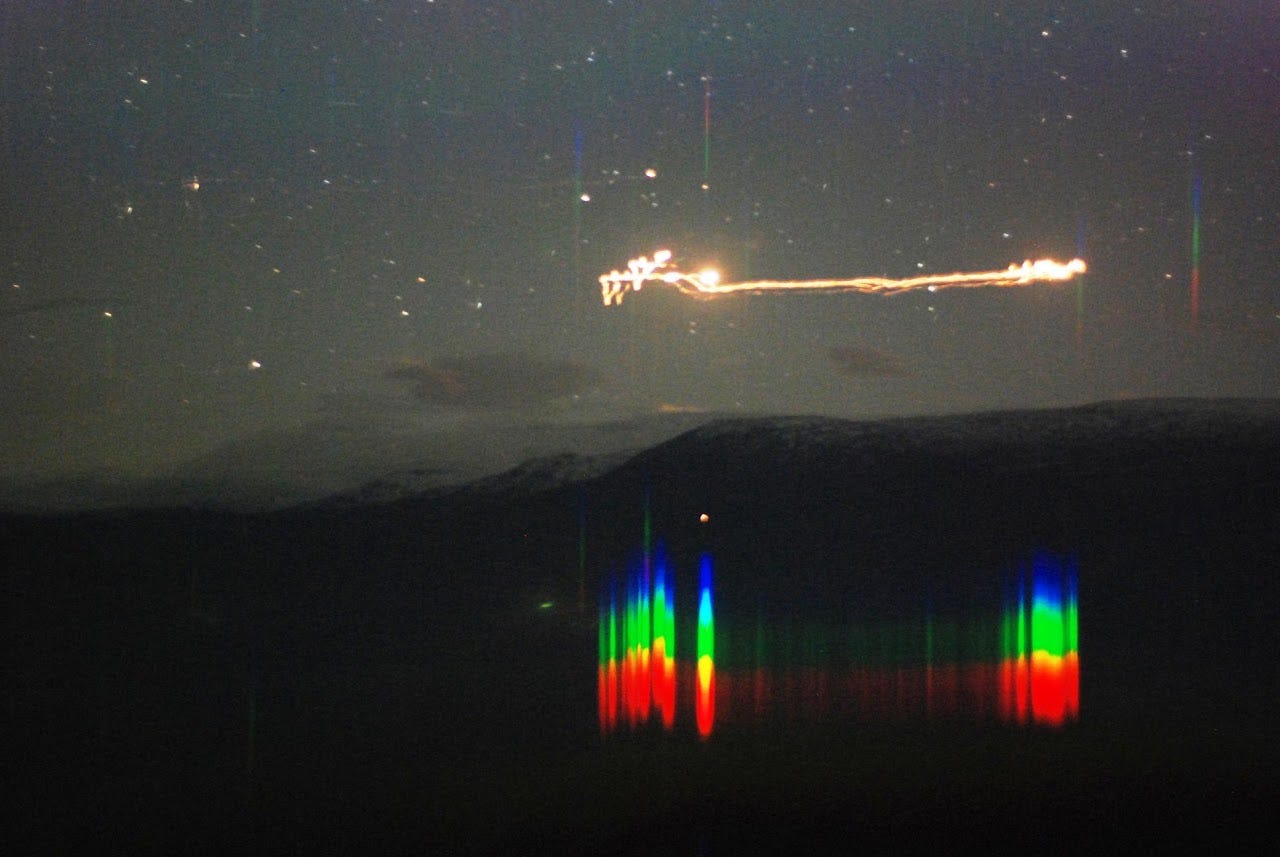
A September 2007 spectral photo of the Hessdalen lights. Scientists say the lights could help explain recent UFO incidents disclosed by the War Department. (Project Hessdalen)
Scientists who have studied a rare aerial phenomenon in Norway tell PARADIGM it could shed light on two of the most notable cases revealed by the Trump administration’s ongoing UFO disclosures.
Both UFO cases involve recent eyewitness reports by U.S. officials of luminous orbs behaving in ways that have defied explanation.
Experts on the Hessdalen lights, a luminous phenomenon observed for decades over a Norwegian valley, said that similarities with the UFO cases could point to a shared underlying mechanism. Some further suggested that the local geology at the sites of these incidents could play a role in the formation of the orbs.
FIRST UFO INCIDENT
The first incident occurred over the course of two days in October 2023 in the Western U.S. and was initially disclosed in the first tranche of UFO files, released in May. In the course of that incident, six federal law enforcement agents observed luminous orbs around dusk near a sensitive national security site, according to documents released by the War Department, which describe the setting as a mountain valley.
A memo about the incident prepared by the Pentagon’s All-domain Anomaly Resolution Office (AARO) reports that the most distinctive feature of that incident was a “luminous orange ‘mother orb’ [that] appeared to produce smaller red ‘orbs,’ one after another, multiple times over a period of several hours.”
SECOND UFO INCIDENT
The second incident occurred late last year and was disclosed in the second tranche of UFO files. During the incident, an unnamed senior U.S. intelligence official reported observing luminous orbs from a helicopter. Ground teams reportedly tracked a hot, low, fast-moving object that “split into two and changed direction.”
HESSDALEN LIGHTS
Since at least the 1930s, mysterious lights of various shapes, colors and movement patterns have been periodically observed in the sky above the Hessdalen valley in rural Norway. The nature of the lights remains a subject of debate, but scientists have proposed they could be composed of plasma. Others have proposed that unusual local geology could be responsible for creating a charged electric field over the valley that fosters the formation of the lights.
Notably, a 2004 study of the lights by Massimo Teodorani, an Italian astrophysicist, documents “ejection of mini light balls” from a larger ball of light — behavior similar to that of the “mother orb” observed in the October 2023 UFO incident.
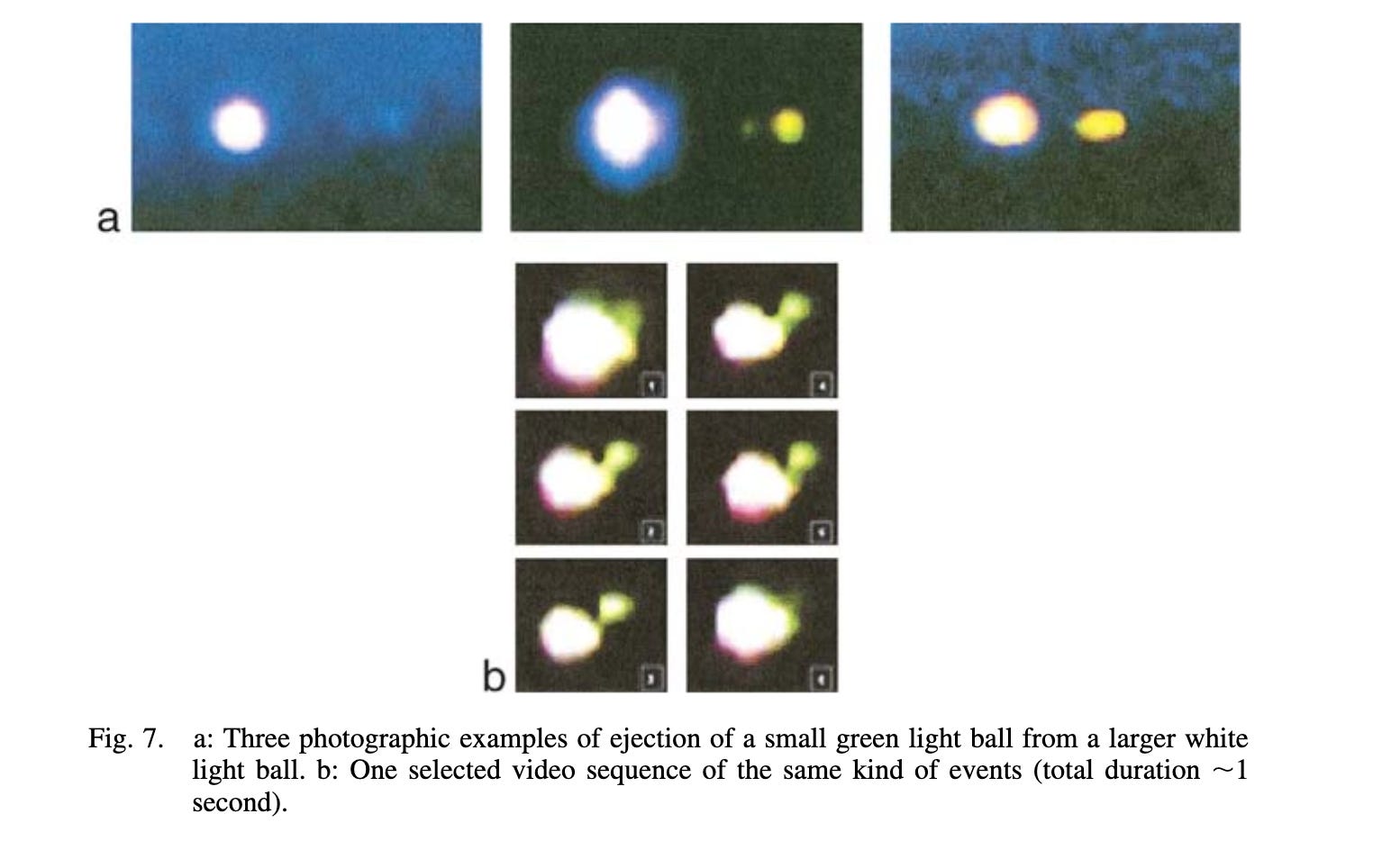
Figure from Massimo Teodorani’s “A Long-Term Scientific Survey of the Hessdalen Phenomenon” (published in the Journal of Scientific Exploration, 2004)
After noticing similarities between the UFO incident reports and descriptions of the Hessdalen lights, PARADIGM emailed nine scientists who have published research on the lights to share details of the UFO cases and ask about a potential connection.
Seven responded, sharing their opinions on a possible overlap or providing information about observations at Hessdalen that could shed light on the UFO cases.
Jader Monari, an Italian engineer who has studied Hessdalen since the 1990s, said the mechanisms behind the lights could also explain the unusual observations from the UFO incidents:
“According to our studies, the unique geology of the Hessdalen valley acts as a massive natural ‘macro-battery,’ capable of generating charged, luminous plasmoids. In light of this model:
The emission of smaller spheres (orbs): In plasma physics, this phenomenon can be understood as a form of thermal self-regulation. A high-energy plasmoid expels clusters of secondary plasma to dissipate excess energy.
Splitting and sudden changes in direction: Being composed of plasma rather than structured solid matter, these objects are not bound by the normal limits of aerodynamics. They respond instantly to fluctuations in electromagnetic fields. A plasma sphere can split (similar to mitosis) if its internal magnetic containment field destabilizes, and it can accelerate or change direction without the inertia typical of conventional aircraft.”
Monari added, “Many maneuvers that might appear ‘intelligent’ or tactical to military personnel actually correspond to the geometric self-organization of complex plasmas.”
Brazilian physicist Gerson Paiva, who has proposed a “dusty plasma” model to explain the formation of the lights, said the 2023 and 2025 UFO incidents were consistent with that framework:
“Both can be explained by the dusty plasma model and its interaction with very low frequency (VLF) electromagnetic waves. Both reports provide an excellent description of how these UAPs appear and move through the air. They also present characteristics of these orbs—such as the color of the emitted light and their lifespan—that align with the characteristics of the model.”
Teodorani, author of the 2004 study, wrote, “there are many similarities with the manifestations of the Hessdalen phenomenon.”
Noting a reference to a cave near the site of orb activity in the 2025 UFO incident, Teodorani shared that Hessdalen is “full of” caves. He said he saw other overlaps — luminous phenomena emerging from the ground, floating just above it, and transforming into geometric objects — between the UFO reports and his observations at Hessdalen.
Teodorani suggested that “piezoelectricity,” a phenomenon in which certain materials, such as minerals in the ground, generate an electrical voltage in response to physical stress, could explain these luminous orbs.
Anna-Lena Kjøniksen, co-author of a 2024 study of Hessdalen, suggested that more information about the UFO incidents would help in evaluating a possible connection. “It is difficult to say from just the reports, but it is possible that the phenomena in the reports are similar to the Hessdalen lights,” she wrote.
Bjørn Gitle Hauge, a Norwegian electrical engineer who has studied Hessdalen for more than 30 years, said he documented an event at Hessdalen in which one luminous object appeared to split into two red lights — an observation reminiscent of the 2023 UFO incident.
Norwegian electrical engineer Erling Strand, chairman of Project Hessdalen, also said that his team observed aerial lights splitting into two at Hessdalen. “We saw it on the radar screen,” wrote Strand, who has been studying Hessdalen for more than 40 years.
Greek geophysicist George Vargemezis, lead author of the 2024 study, argued that the presence of conductive ores in the ground around Hessdalen was a crucial factor in the appearance of the lights. “It would not surprise me,” he added, “if comparable conditions were found in other regions where similar phenomena have been reported.”
THE BRAZILIAN CONNECTION
There is also speculation that the UFO incidents could be the result of human technology.
AARO’s memo about the October 2023 incident finds that natural phenomena, such as ball lightning, are “unlikely” to explain the event, citing factors like weather conditions.
The memo finds the possibility that the UFOs were the products of American military systems to be “plausible” but “inconclusive.” It cites unusual military flares as a candidate explanation for some of the observations, and finds that 60 percent of the reported behavior could be “plausibly attributable to military aircraft”:
“The characteristics described in the agents’ narrative account align with those of certain U.S. military technologies. However, the historical records are inconclusive regarding whether those technologies were present at the time and place of the reported incident.”
The report adds that no single U.S. technology could account for the entire UFO report on its own.
One of the Hessdalen researchers suggested that the UFOs could be related to the Norwegian lights and also be the product of secret U.S. military systems, based on an encounter he had in Brazil 20 years ago.
Paiva told PARADIGM that after he published a 2007 paper in which he reported the creation of luminous orbs resembling ball lightning in a lab, a U.S. Air Force official approached him to propose a research collaboration.
Paiva said he met with James Fillerup, then serving as point man in Latin America for the Air Force Office of Scientific Research.
The Air Force Research Laboratory did not respond to requests for comment.
Paiva declined to collaborate with the military, but the encounter has stuck with him. He said he has interpreted the approach as being motivated by a desire on the part of the Air Force to be able to create luminous plasmas that resemble many UFO reports.
Fillerup, now retired, confirmed the meeting, though participants differ on the extent to which UFOs figured into the encounter.